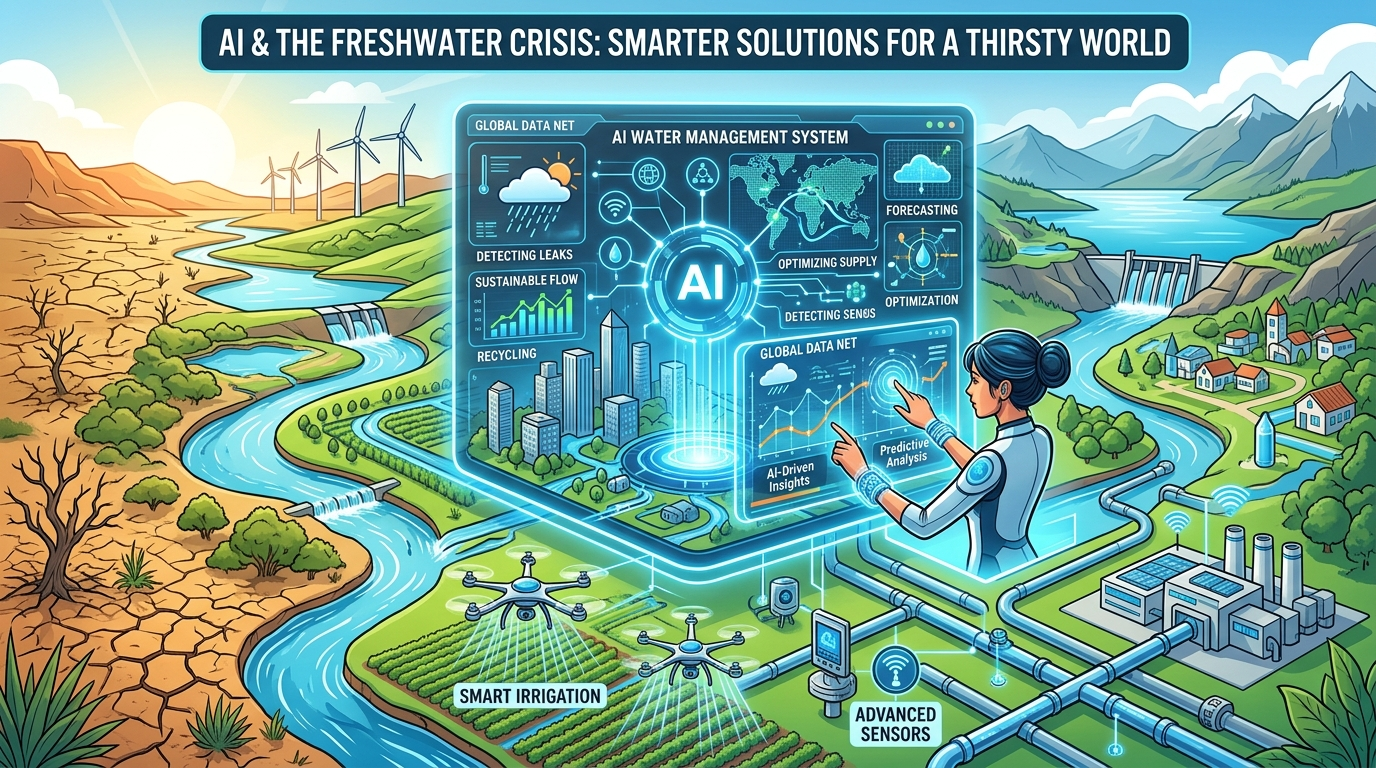
AI has joined the fight to protect us against the looming freshwater crisis.
So what exactly is this crisis? Here’s a good read from the World Economic Forum titled, Global Freshwater Demand will Exceed Supply by 40% by 2030.
The title of the above article pretty much explains it. To be clear, we will NOT run out of freshwater. We will, however, have severe water shortages, large displacement of populations and aquifer depletion. (underground water reserves)
The AI Paradox
Before we get to far into this, it’s important to point out the paradox. Currently AI requires a large amount of freshwater for cooling purposes, but lets put that into perspective. Here’s a quick rundown.
- Agriculture: ~70% (Irrigation, livestock, feed crops)
- Industrial & Manufacturing: ~15% (Textiles, metals, chemicals, semiconductor production)
- Energy Production: ~10% to 15% (Cooling power plants, fuel extraction/refining)
- Municipal / Household: ~10% to 13% (Drinking, sanitation, residential landscaping)
- All Data Centers Combined (Cloud, Streaming, Tech): ~0.1% to 0.3%
- AI Specifically: A tiny slice of that ~0.2% data center bucket (though growing rapidly).
The numbers shown above for AI are also setup to drop considerably. Review my previous article called AI Drinking The World Dry? for insights on how this is being done today.
The paradox is simply this. AI requires large amounts of freshwater to cool the systems. However, AI is also assisting in the fight to save freshwater.
The Multi-Modal Picture
The looming freshwater crisis is only part of the picture. Our planet is in crisis on many fronts. In this article we’ll talk about freshwater specifically, however, the larger war to save the planet requires recycling, circular economy and addressing climate change and replacement of natural resources. I’ve written a number of articles in these areas.
Can We Recycle Our Way Out of E-Waste?
AI Research to Replace Finite Resources
You can find a complete list of AI and the environment in my category on Environment.
AI Joins the Fight To Prevent Freshwater Crisis
Let’s take a look at how, exactly, AI is helping in this fight. I’ll break it down into tiers. Tier 1 is what AI is doing today, tier 2 are projects in the pipeline (3-5 yrs out) and lastly, tier 3 are future projects.
Tier 1: Right Now – Today (Scaling Commercial Solutions)
These projects rely on existing, proven technologies that are being deployed worldwide to stabilize regional water supplies immediately.
- Advanced Wastewater Recycling (Direct Potable Reuse – DPR):
- What it is: Transforming municipal wastewater directly into purified, high-grade drinking water using multi-stage reverse osmosis, microfiltration, and ultraviolet disinfection.
- Active Examples: Pure Water SoCal (California) and expanding operations in Singapore (NEWater). Advanced purification facilities process hundreds of millions of gallons of sewage daily, injecting it directly back into local reservoirs or drinking water networks.
- Smart Agricultural Irrigation (Drip + IoT Sensing):
- What it is: Transitioning agriculture away from wasteful flood or sprinkler irrigation. Farms integrate subterranean drip tape paired with soil-moisture IoT sensors, weather forecasting AI, and variable-rate application.
- Active Examples: Companies like Netafim and CropX are upgrading farms across North America, Israel, and Southern Europe. Replacing sprayers with underground drip irrigation reduces agricultural water consumption by 30% to 50% while improving crop yields.
- Modular Industrial Water Reclamation:
- What it is: Closed-loop systems installed directly on-site at high-water industrial facilities (e.g., semiconductor fabs, textile plants, and data centers). Instead of discharging wastewater, facilities process and reuse up to 98% of their process water.
- Active Examples: Semiconductor giant TSMC operates Zero Liquid Discharge (ZLD) plants in Taiwan and Arizona that continually recycle millions of gallons of process water.
Tier 2: Pipeline Projects (3–5 Years Out)
These technologies are moving from advanced pilot programs to commercial viability. Expect them to see widespread adoption within the decade.
- Graphene & Nanocomposite Desalination Membranes:
- What it is: Traditional Seawater Reverse Osmosis (SWRO) consumes massive amounts of electricity because water must be forced through thick plastic membranes under high pressure. Next-generation membranes engineered with graphene oxide or metal-organic frameworks (MOFs) feature ultra-thin, highly porous surfaces that let water pass with significantly less resistance.
- Impact: Cuts the energy cost of seawater desalination by 20% to 40%, drastically lowering carbon emissions and operational expenses.
- Atmospheric Water Generation (AWG) at Scale:
- What it is: Moving beyond small household dew-catchers to industrial-scale atmospheric water harvesters. Utilizing advanced liquid sorbents or metal-organic frameworks powered by waste heat or solar energy, these systems pull clean drinking water directly out of low-humidity air.
- Impact: Startup firms (e.g., Avnos, SOURCE Global) are scaling systems capable of providing localized drinking water off-grid in landlocked, drought-stricken communities without depleting local aquifers.
- AI-Driven Infrastructure Leak Detection:
- What it is: Municipal water networks globally lose an estimated 30% to 50% of treated drinking water to hidden underground leaks before it ever reaches a tap. Deploying acoustic sensors inside pipes paired with satellite radar imagery and predictive AI pinpoints microscopic stress fractures before catastrophic bursts occur.
Tier 3: Future Moonshots (> 5 Years)
These concepts are currently restricted to research labs, early university prototypes, or theoretical engineering models, but could fundamentally alter global water supply dynamics if brought to scale.
- Solar Thermal “Zero-Energy” Desalination:
- What it is: Completely decoupling desalination from power grids. Passive, multi-stage solar stills utilize advanced light-absorbing materials to vaporize seawater using direct sunlight, condensing pure water without relying on pumps, electricity, or fossil fuels.
- Vision: Providing unlimited, low-cost freshwater to coastal developing nations without placing extra burden on electrical grids.
- Electrochemical Brine Elimination (Mining the Sea):
- What it is: Conventional desalination creates a hyper-saline byproduct called brine, which threatens marine ecosystems when pumped back into the ocean. Future electrochemical plants aim to split desalination waste into industrial chemicals (like hydrochloric acid, sodium hydroxide, and battery-grade minerals like lithium) while producing additional fresh water.
- Vision: Turning desalination waste from an environmental hazard into a profitable raw material stream.
- Bio-Engineered Drought-Tolerant Crops (Deep Roots & CAM Photosynthesis):
- What it is: Genetic modification using CRISPR to rewrite the photosynthetic pathways of primary global staples (wheat, corn, rice). Researchers are attempting to engineer crops to use CAM (Crassulacean Acid Metabolism)—the system cacti use—allowing plants to absorb carbon dioxide at night, drastically cutting daytime transpirational water loss.
- Vision: Redefining global food production by enabling crops to thrive using a fraction of current agricultural water inputs.
Side Rant – The Media
If you’ve read my articles previously you know I’m not a fan of the main stream media. This is another example of where I think the media is failing us. Let’s start by defining journalism. I’ve taken the below definition directly from a Google search.
Journalism is the activity of gathering, verifying, assessing and presenting news and information to the public.
Purpose of Journalism
- Inform citizens: Provide people with the facts they need to make smart choices about their lives and communities.
- Act as a watchdog: Hold powerful people, governments, and large institutions accountable.
- Protect democracy: Give the public an independent voice and a clear view of current events.
Main Types of Journalism
- News reporting: Quick, factual updates about recent events.
- Investigative reporting: Deep research into a single topic to uncover hidden truths or corruption.
- Feature writing: In-depth stories focusing on human interest, trends, or specific people.
- Photojournalism: Telling stories primarily through pictures and video.
Given the above definition, I’m of a mind that main stream media is failing us. Does the media think running into a freshwater drinking crisis isn’t important enough to report on? Make no mistake, once entire populations are displaced, prices soar, and violence breaks out, the media will be all over that. Shame on you main stream media.
Kudo’s To Those That Do Report
There are many outside the mainstream media that do track and report on the environment. This ranges from independents to investigative, science based and globally based agencies. These organizations have the integrity to report on the environment where our main stream media fails us. I’d like to extend my appreciation to all.
Independent & Non-Profit Newsrooms
- Inside Climate News: An independent, non-profit, non-partisan news organization dedicated to covering climate change, energy, and the environment.
- Grist: A non-profit independent media organization focusing on climate solutions, environmental justice, and sustainable policy.
- Circle of Blue: A specialized team of journalists and researchers reporting on the global freshwater crisis and its intersection with food, energy, and climate.
- Mongabay: A non-profit conservation and environmental science news platform with a network of global correspondents covering tropical forests, ocean health, and biodiversity.
- The Margin: A non-profit publication that specifically centers on environmental justice, highlighting communities most affected by pollution and climate change.
Investigative Journalism Centers & Collaboratives
- ProPublica: An independent, non-profit newsroom that produces investigative journalism, regularly featuring deep dives into environmental regulation, corporate pollution, and resource management.
- Environmental Reporting Collective (ERC): A collaborative network of investigative journalists and newsrooms globally, focusing on cross-border environmental crimes, illegal logging, and wildlife trafficking.
- The Pulitzer Center (Environment & Climate Reporting): Grants funding to independent journalists around the world to report on underreported systemic environmental issues.
Science-Focused & Academic Outlets
- The Conversation (Environment & Energy Section): An independent news source publishing articles written by academic researchers and scientists, edited by professional journalists for the public.
- Yale Environment 360 (E360): An online magazine published at the Yale School of the Environment, featuring opinion, analysis, reporting, and debate on global environmental issues.
- Nature News / Science News: Independent editorial wings of major scientific journals that report on environmental research, ecosystem studies, and peer-reviewed climate data.
Intergovernmental, multilateral, and governmental agencies produce primary data, raw scientific monitoring, and regulatory reports on environmental issues.
1. Global Multilateral & UN Bodies
These organizations operate through international treaties, combining data from member nations to issue comprehensive global benchmarks.
- United Nations Environment Programme (UNEP): The primary UN agency overseeing environmental policy. They produce foundational publications like the Global Environment Outlook (GEO) and annual emission gap reports.
- Intergovernmental Panel on Climate Change (IPCC): A joint body of the UN and World Meteorological Organization. They do not conduct original research, but instead aggregate thousands of peer-reviewed studies globally to produce authoritative assessment reports on climate science.
- Food and Agriculture Organization (FAO – Water & Land Divisions): Tracks global agricultural water use, soil degradation, and deforestation, serving as the main source for global agricultural freshwater metrics.
- World Meteorological Organization (WMO – Hydrology Division): Monitors global water cycles, surface water reservoirs, precipitation trends, and extreme weather events.
- World Bank Group (Water Resources Management Division): Tracks water infrastructure, water scarcity economics, and public funding models for freshwater preservation globally.
2. Major National & Regional Government Agencies
Government agencies manage regional regulatory data, groundwater monitoring networks, and pollution tracking.
- US Environmental Protection Agency (EPA): Tracks US surface water quality, air quality indices, municipal toxic release inventories, and regional water supply health.
- European Environment Agency (EEA): The official agency of the European Union providing independent environmental data across European countries.
- US Geological Survey (USGS – Water Resources Mission Area): The primary US science agency tracking real-time streamflow, aquifer depletion rates, and groundwater levels.
- Environment and Climate Change Canada (ECCC): Oversees Canadian freshwater protection, ecosystem monitoring, and climate metrics.
3. Non-Governmental Policy & Economic Forums
These non-state entities bring together business leaders, governments, and scientific institutes to evaluate resource risks.
- World Economic Forum (WEF – Centre for Nature and Climate): Publishes the annual Global Risks Report, which consistently ranks water crises and biodiversity loss among the top long-term threats to global economic stability.
- World Resources Institute (WRI – Water Program): A non-profit research coalition that operates the Aqueduct Water Risk Atlas, mapping global water stress and regional groundwater depletion.
- International Union for Conservation of Nature (IUCN): A global authority on ecosystem health and species preservation, best known for maintaining the IUCN Red List.
Summary
Our planet has many problems and yes, we are facing a crisis on fresh drinking water. Additionally AI is here to help and assist in our struggle to avert this crisis. Before folks scream nay on building AI data-centers, ask the important questions. Will my electrical bill go up? What will it do to our local freshwater supply? If you like more detail around what’s going on within the construction of data centers, read my article called AI Data Centers.
Look, we have complex problems in a complex world. Pretending they don’t exist solves nothing. Identify the problems, report on the problem, inform the masses on what’s going go. We CAN make a difference if we’re informed and focused on solving problems.
As always, thanks for reading. Feel free to drop a comment below. Let’s get the word out. We can make a difference.