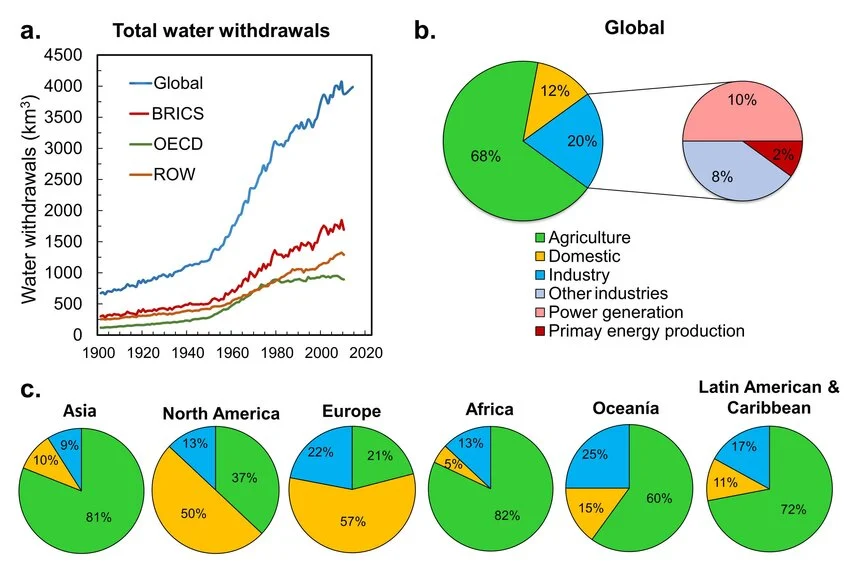
Are AI data-centers drinking the world dry? Short answer is no, they are not. Is the world facing a crisis of available fresh drinking water? The answer here is yes, we are. While AI data-centers are playing there role in the consumption of freshwater, they are also doing something about it. It’s not just data-centers or tech in general, it’s agriculture and faulty infrastructure that’s taken a big toll on overall freshwater usage. To say that AI data-centers are drinking the world dry is an overstatement.
Current State
According to the WEF (World Economic Forum) 5 billion people will be without fresh drinking water by 2050. Others place this timeline as low as 2040. The main causes are climate change and urbanization. For additional insights and projects, you can review my previous article titled, AI to Help Drinking Water Issue.
Why AI Specifically?
So why do the headlines specifically target AI? The answer here is simple. Fear sells. This is not to say AI and data-centers do not play a role, they absolutely do. However, as a percentage of overall usage, it pales in comparison to agricultural which is the highest consumer of freshwater. Here’s some example:
- Agriculture: Farming is the largest water consumer globally. Growing the feed for the dairy and meat industries consumes trillions of gallons. Even specific crops like U.S. corn use over 70 times more water annually than all the world’s AI servers combined.
- Energy Production: Generating the electricity for our daily lives relies on power plants (including nuclear and fossil fuels) that use vast quantities of water for cooling and steam generation.
- Everyday Streaming: While a single AI prompt requires a small amount of water to cool data center servers, global streaming platforms use about 40 times more total energy—meaning their indirect water footprint for power generation dwarfs AI
So What is AI Doing To Help?
I’ve written about some current projects underway here. Instead of rehashing that, let’s look at what is going on today.
| AI-Optimized Dynamic Cooling | This is fully implemented. Google, Microsoft, and AWS have integrated AI systems into their infrastructure for years. Using machine learning to continuously tweak airflow, pump speeds, and cooling cycles based on real-time weather has already reduced cooling energy footprints by up to 40%. |
| Direct-to-Chip Liquid Cooling | This has transitioned from an elective upgrade to an absolute necessity. Modern AI microchips run so hot that traditional air cooling literally cannot keep up. Data center cooling markets show that direct liquid cooling—where closed-loop liquids run directly over the chips without evaporating water—now accounts for over 38% of new high-density installations. |
| Predictive Grid Management | AI models are actively used by utility companies to forecast renewable energy generation (wind/solar) to prevent clean energy waste, keeping data centers aligned with actual green power availability |
Late Stage AI Projects
While the above projects are being implemented today, there are additional projects in later stages of development and testing. The current timeline for implementation of below is 3 to 5 years out. Still well before the earliest prediction of 2040 for the coming freshwater crisis.
| Workload and Load Shifting | The concept of “chasing the sun”—using AI to automatically shift heavy, non-urgent AI training workloads to data centers in parts of the world where renewable energy or cool ambient air is peaking—is being actively scaled by major cloud providers. It is operational in clusters but not yet fully automated across the global web. |
| Alternative Water Sources | Major tech companies have pledged to become “water positive” by 2030. To get there, newer facilities are being designed to run on treated industrial wastewater or municipal grey water rather than tapping into local drinking water. This is a standard architectural blueprint for facilities being built today. |
| Immersion Cooling | Instead of piping liquid to a chip, entire server racks are submerged in a specialized, non-conductive dielectric fluid that absorbs heat with zero water evaporation. This technology is highly proven and growing rapidly, though retrofitting older data centers to support the weight of these liquid vats takes time |
The Future
The future contains significant improvements yet remain a decade away from a significant impact. A decade puts us very close to the earliest estimates of the freshwater crisis, 2040. However, it could be implemented prior to the other prediction of 2050. So while the below technologies are geared more towards the future, it’s an excellent way of showing how AI is not only concerned with the immediate need, but is also planning for the future.
| Dedicated AI Managed Microgrids | While companies like Microsoft and Amazon have signed deals to buy power from upcoming Small Modular Nuclear Reactors (SMRs) or advanced geothermal plants to go entirely off-grid, the physical infrastructure isn’t built yet. Regulatory hurdles and construction timelines mean true, off-grid AI microgrids are largely a post-2030 reality |
| Data Center Waste Heat for Water Purification | Recent academic research has proposed a brilliant “circular” concept: taking the massive waste heat generated by AI servers and using it to thermally desalinate ocean water or purify wastewater, effectively making data centers “water-positive” manufacturing plants. While mathematically sound, this is strictly in the prototype and research phase. |
| Circular AI | The ultimate goal. At a high level, Circular AI is the application of circular economy principles—reduce, reuse, recycle, and regenerate—to the entire lifecycle of artificial intelligence. Instead of a linear “take-make-waste” model, Circular AI focuses on making AI hardware and operations self-sustaining and closed loop. |
Summary
Above explains what some call the solving the water paradox. Yes, AI and data-centers do require freshwater for cooling. However, as above points out it’s a small percentage of overall usage. Additionally, the tech industry is taking responsibility and making moves today to limit its impact on the environment. I think it would be short sighted and actually irresponsible to not use AI towards solving the worlds freshwater upcoming crisis.