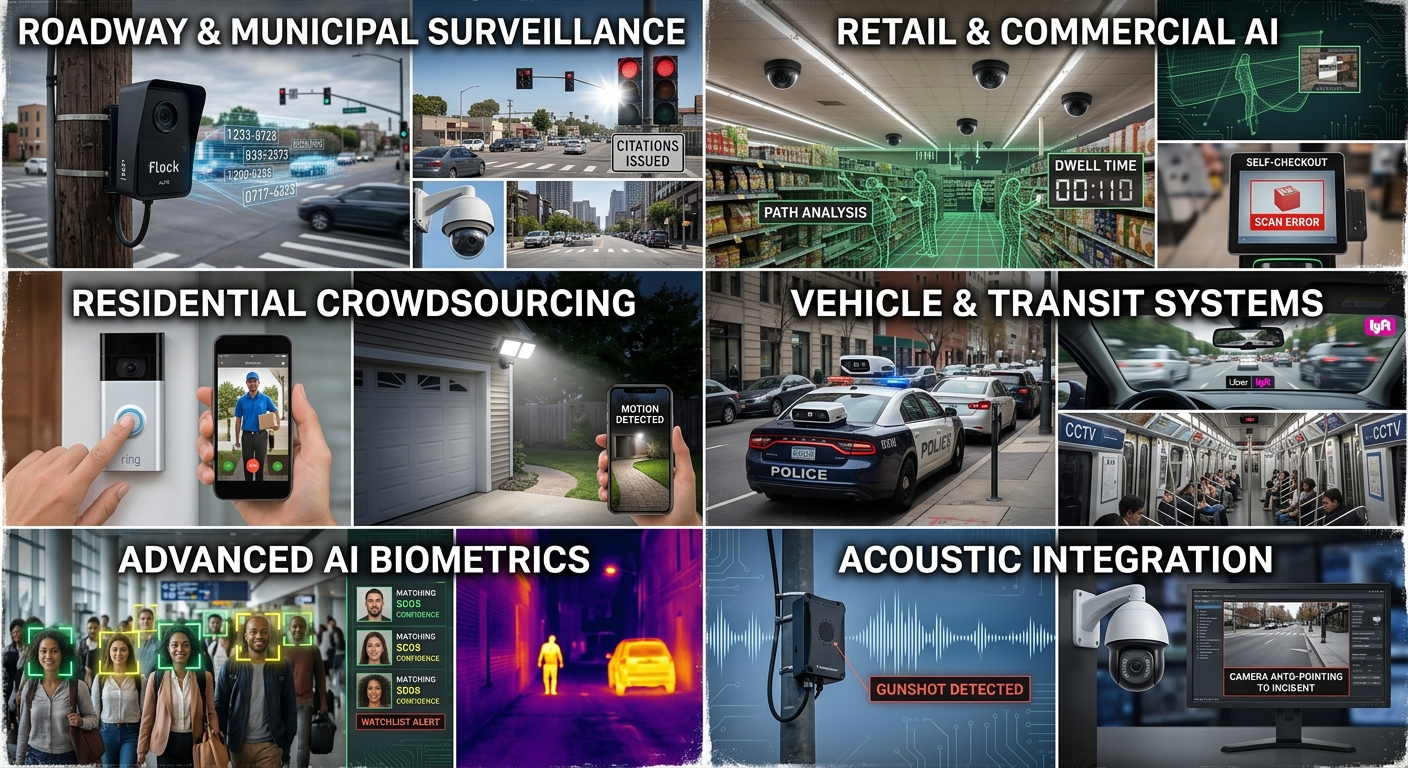
The Flock cameras are just another tool within the surveillance package of tools.
To gain clarity, flock cameras are ALPR (Automated License Plate Readers). They are not used for facial recognition or speed enforcement that automatically issue tickets.
Here’s what the manufacturer has to say. Flock Cameras.
Surveillance Today
Today there are a wide assortment of cameras watching us. Verkda lists out the surveillance in their article Types of Security Cameras: The Complete Guide to Video Surveillance Systems.
1. Fixed Roadway & Municipal Cameras
- Automated License Plate Readers (ALPR): Mounted on utility poles, overpasses, or mobile trailers. These read plates and capture vehicle metadata (make, model, color, damage).
- Traffic Control & Red-Light Cameras: Positioned at intersections and toll booths to monitor traffic flow, catch speeders/red-light runners, and issue automatic citations.
- Pan-Tilt-Zoom (PTZ) Public Safety Cameras: Prominent, often globe-shaped dome cameras mounted on city streetlights. Operators in Real-Time Crime Centers (RTCCs) can remotely rotate, tilt, and zoom these in high-definition.
2. Commercial & Retail Infrastructure
- AI-Enhanced Overhead Cameras: Found in grocery stores, malls, and big-box retailers. Beyond loss prevention, they analyze foot traffic heatmaps, dwell times, and shopper demographics (age, gender estimation).
- Self-Checkout & Point-of-Sale (POS) Monitors: Micro-cameras embedded directly into checkout terminals, registering scanned items versus physical cart movements to flag unscanned items.
- Dome & Vandal-Proof Cameras: Compact, tinted dome housings mounted on store ceilings. The dark dome conceals which direction the lens is pointing.
3. Residential & Crowdsourced Surveillance
- Smart Doorbell Cameras: Embedded in front doors, constantly recording foot traffic, delivery workers, and neighbors. Many link to neighborhood networks (e.g., Amazon Ring, Nest) or local police sharing portals.
- Floodlight & Outdoor Security Cameras: Wall-mounted perimeter cameras guarding driveways and backyards, frequently equipped with motion-detection, infrared night vision, and continuous cloud backup.
4. Vehicle & Transit-Based Surveillance
- Mobile ALPRs (Police Patrol Cars): Roof-mounted camera pods on police cruisers that scan hundreds of license plates per minute while patrolling or driving through parking lots.
- Dashcams (Rideshare & Fleet): Front- and interior-facing cameras inside Ubers, Lyfts, taxis, and delivery trucks recording drivers, passengers, and surrounding traffic.
- Public Transit CCTV: Multi-angle cameras installed on buses, trains, and subway platforms monitoring passengers and enforcing safety.
5. Advanced & AI Surveillance Technologies
- Facial Recognition Systems (FRT): High-definition CCTV feeds integrated with AI software that match faces in crowded areas (airports, stadiums, city centers) against law enforcement or private watchlists in real time.
- Thermal & Infrared Cameras: Detect heat signatures instead of visible light, used for perimeter detection, search-and-rescue, or spotting people through darkness, smoke, or dense foliage.
- Acoustic-Integrated Cameras: Security systems linked with acoustic arrays (like ShotSpotter or Flock Raven) that automatically spin and point toward sudden loud sounds like gunshots or breaking glass.
Pro’s and Con’s
When analyzing surveillance, the core ethical balance sits between collective security/convenience (the pros) and individual autonomy/privacy (the cons). Every camera system shifts this balance differently depending on who owns the tech, who has access to the data, and whether you can reasonably opt out.
1. Fixed Roadway & Municipal Cameras (ALPRs, Traffic, PTZ)
- Ethical Pros:
- Objective Evidence Gathering: ALPRs and traffic cameras objectively record vehicle data (license plates, make, model) without relying on human memory or subjective officer impressions.
- Public Safety & Recovery: Helps law enforcement rapidly locate stolen vehicles, abducted children (Amber Alerts), and dangerous suspects moving through arterial roadways.
- Ethical Cons:
- Continuous Mass Tracking: Creates a searchable, historic map of a citizen’s daily movements—where you work, worship, socialize, or seek medical care—violating reasonable expectations of spatial privacy.
- Function Creep & Data Sharing: Data collected for public safety is often sold, shared across state lines, or queried by third-party private databases without clear warrant requirements or public oversight.
2. Commercial & Retail Infrastructure (Smart Retail, POS, Dome Cameras)
- Ethical Pros:
- Loss Prevention & Safety: Helps protect small businesses and retail workers from shoplifting, organized retail crime, and violence.
- Consumer Experience: Foot-traffic heatmaps and POS monitoring streamline store layouts, keep prices stable by reducing shrink, and reduce checkout wait times.
- Ethical Cons:
- Unconsented Biometric Profiling:AI overhead cameras may scan shoppers for demographic data (age, gender, mood, or facial signatures) without explicit opt-in consent.
- Asymmetric Power Dynamics: Customers and low-wage employees are subject to constant behavioral scoring and monitoring, creating a high-stress workplace environment.
3. Residential & Crowdsourced Surveillance (Smart Doorbells, Floodlight Cameras)
- Ethical Pros:
- Property Protection & Autonomy:Homeowners gain peace of mind, porch-pirate deterrence, and direct control over their immediate living environment.
- Crowdsourced Neighborhood Watch: Residents can voluntarily share footage to help neighbors resolve hit-and-runs or local break-ins.
- Ethical Cons:
- Surveilling the Public Sidewalk: Fixed home cameras frequently capture public sidewalks, neighboring yards, and delivery workers who cannot opt out of being recorded.
- Vigilantism & Profiling: Community video-sharing networks (like Neighbors or Nextdoor) can amplify racial profiling, paranoia, and false accusations over innocent everyday activities.
4. Vehicle & Transit-Based Surveillance (Dashcams, Police Mobile ALPR, Transit CCTV)
- Ethical Pros:
- Accountability & Liability: Dashcams provide objective visual proof in traffic accidents, protecting drivers from insurance fraud and holding public transit operators accountable.
- Deterrence in Enclosed Spaces: Visible transit CCTV deters harassment and assault in high-density, captive environments like subways and buses.
- Ethical Cons:
- Worker & Passenger Micro-Surveillance: Continuous cabin monitoring creates a “panopticon effect” for rideshare and transit drivers, tracking every movement, glance, or private conversation.
- Passive Dragnet Scanning: Mobile ALPRs mounted on police cruisers continuously scan thousands of parked, law-abiding vehicles every hour simply while driving down public streets.
5. Advanced & AI Surveillance (Facial Recognition, Thermal, Acoustic Arrays)
- Ethical Pros:
- High-Threat Interdiction:Allows security teams in massive crowds (airports, stadiums) to quickly flag known violent offenders, missing persons, or active security threats.
- Rapid Incident Response: Acoustic systems (like ShotSpotter/Raven) immediately alert emergency services to gunshots or crashes, even if no one calls 911.
- Ethical Cons:
- Algorithmic Bias & Misidentification:Facial recognition algorithms have historically demonstrated higher error rates for women and people of color, leading to wrongful arrests and civil rights violations.
- Chilling Effect on Free Speech:Deploying facial recognition in public places destroys anonymity, deterring citizens from attending political rallies, protests, or private gatherings out of fear of state profiling.
Summary of the Ethical Spectrum
| Tech Category | Primary Beneficiary | Core Ethical Trade-Off |
| Municipal / ALPR | Law Enforcement | Public Safety vs. Freedom of Unmonitored Movement |
| Retail & Commercial | Private Business | Loss Prevention vs. Unconsented Consumer Profiling |
| Residential / Doorbells | Homeowners | Property Security vs. Neighborly Privacy & Bystander Consent |
| Transit & Dashcams | Fleets & Insurers | Accident Accountability vs. Constant Worker Surveillance |
| AI / Facial Recognition | High-Security Entities | Rapid Threat Detection vs. Bias, Errors, & Destruction of Anonymity |
What Does This Mean?
When does technology help us vs hurt us or invade on our privacy? Everyone seems to have strong opinions one way or the other. Personally, for me, what this technology does is make us think. How do we maintain law and order and what are we willing to give up in order to achieve that?
We don’t live in a Utopian society, far from it, but we also don’t want to live in a surveillance state either. If I were a victim of a crime, I would want every available tool law enforcement has to capture the criminal. If I were debating this in the comfort of my own home sipping coffee, I have the luxury of being more objective to weigh the pro’s and the con’s. You see the difference? I believe this requires more than a binary yes/no answer.
Moving Past All or Nothing
Finding a balance between actionable law enforcement utility and fundamental civil liberties requires moving away from all-or-nothing approaches. A workable, objective baseline framework built around five core principles can protect privacy without crippling legitimate policing.
1. Strict Purpose & Operational Limits
Surveillance systems should operate under clear, narrow boundaries rather than acting as open-ended dragnets.
- Specific Target Mandates:Law enforcement should only query surveillance databases using specific parameters (e.g., a specific license plate linked to a felony warrant or missing person case), never for exploratory searches or general neighborhood sweeps.
- Mandatory Case Code Logging: Analysts and officers must enter an active, verifiable case number before performing any query or database lookup.
- Express Prohibitions:Systems must be statutorily banned from monitoring First Amendment-protected activities (protests, political rallies, religious services) or sensitive locations like healthcare clinics and reproductive health providers.
2. Mandatory Data Ephemerality (Short Retention Defaults)
The single biggest threat to spatial privacy is long-term storage, which allows the state to retroactively track a person’s life over months or years.
- 7 to 30 Day Auto-Purge: Unflagged, routine surveillance data (e.g., a vehicle passing a camera with no hotlist hit) must automatically auto-delete within 7 to 30 days.
- Evidence Preservation Threshold: Data can only be retained past the default window if it is explicitly flagged and locked as evidence in an active civil or criminal investigation under strict court oversight.
3. Auditing, Access, and Anti-Siloing
Data security and accountability rely on preventing unauthorized internal access and unmonitored sharing across agencies.
- Immutable Audit Logs: Every search, image view, or data pull must generate an unalterable log detailing who searched what, when, and for what logged purpose.
- Proactive Anomaly Alerts: Security software must actively flag suspicious user behavior (e.g., an officer running searches on neighbors, family, or celebrities) and trigger automatic account lockouts pending review.
- Banned Out-of-State / Commercial Resale: Data collected by public surveillance must never be sold to third-party data brokers, shared with non-law-enforcement entities, or routed across jurisdictional lines without an explicit inter-agency agreement.
4. Judicial & Democratic Oversight
Technology adoption and deployment should never happen in secret.
- Community Approval (CCOPS Framework): Police departments should be required to seek explicit city council and public hearing approval before purchasing, funding, or expanding any surveillance technology.
- Annual Impact Reporting: Agencies must publish annual metrics showing how often the tech was used, how many leads were generated, clear statistics on crime resolution rates, and audit results.
- Warrant Requirements for Long-Term Tracking: While instant “hotlist” alerts for active crimes are permitted, compiling historical location profiles spanning multiple days on a specific individual must require a judicial warrant based on probable cause.
5. Algorithmic Guardrails & Biometric Restrictions
Because AI systems carry risks of false positives and bias, strict technological barriers are necessary.
- No Automated Enforcement: AI detections (e.g., an ALPR match or facial recognition hit) must serve strictly as an investigative lead, never as sole probable cause for an arrest or vehicle stop. Human verification must be mandatory.
- Biometric Exclusions: Public domain cameras (like municipal ALPRs or street-level CCTV) should be structurally isolated from real-time facial recognition algorithms unless operating under a specific judicial order for high-threat scenarios.
The Operational Trade-Off Matrix
| Safeguard | How It Protects Privacy | Impact on Law Enforcement |
| 7–30 Day Data Purge | Prevents retroactive long-term profiling of innocent citizens. | Focuses tool on active, real-time leads; forces investigators to secure evidence quickly. |
| Case-Code-Only Searches | Stops officers from using tools for personal monitoring or curiosity. | Adds a few seconds of administrative input per search. |
| Banned Third-Party Resale | Prevents corporate data brokers from building consumer dossiers. | Eliminates non-law-enforcement commercial access. |
| Human In-The-Loop | Eliminates automated arrests based on AI errors or bad reads. | Requires an officer to visually confirm data before initiating a stop. |
Summary
Technology, whether using AI or not requires more than an all or nothing approach. For AI specifically, if we cannot get global agreement on the morality of AI outputs, the only viable governance strategy is structural auditability. We must enforce the ‘how’ (cryptographic verification,
immutability, automated data expiration) even when societies disagree on the ‘what’.
I’ve said many times, it’s not the technology, rather it’s people. We choose how to implement the technology. Perhaps you agree or disagree with the approaches I’ve outlined above. I welcome the debates, for and against because it means we’re thinking. We want safety and we want privacy, as it should be. However, what I don’t agree with is the all or nothing approach.
What do you think? Pro, con or somewhere in the middle?