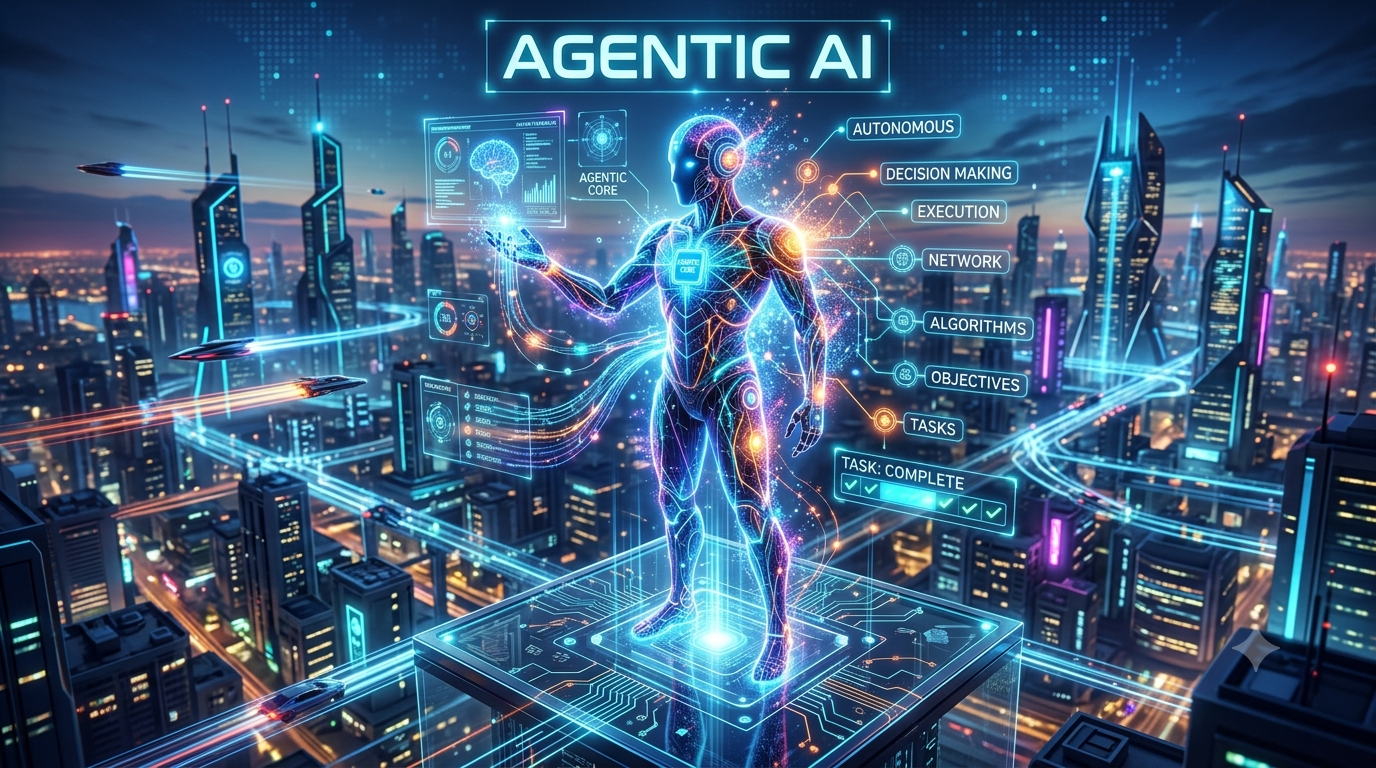
Agentic AI expands beyond simply answering into doing! This is exciting stuff, but before we continue, let’s start out with the definition for our baseline.
Agentic AI
Artificial intelligence that can autonomously plan, reason and take multi-step actions to achieve a goal with minimal human oversight.
Core Characteristics
- Autonomy: Operates and makes decisions without needing constant user guidance.
- Goal Driven Planning: Takes a broad objective and splits it into smaller, sequential steps.
- Tool Integration: Uses software, API’s, and databases to interact with.
- Adaptability: Learns from feedback or changing conditions to adjust its strategy.
Agentic AI – From Answering to Doing
Traditionally AI models respond to one prompt at a time. We’ve all tried this, right? Whether ChatGPT, Gemini or whatever your favorite AI chatbot is. You type in a prompt and the AI responds with an answer. Let’s walk through an example so we clearly see the differences.
Traditional AI – Answering
Prompt: Plan a 5-day vacation to Tokyo.
Response: A great 5 day itinerary, but you still need to book a flight, make hotel reservations and check calendar availability.
Agentic AI – Doing
The game changer is switching from answering to doing. Here our AI agent operates with autonomy.
Prompt: Plan a 5-day vacation to Tokyo
Response:
- Search flight options and pick the best times based on your preferences.
- Reserve the hotel rooms.
- Block out the dates on your calendar.
- Alert you only when it hits a decision that requires your human approval (like pressing pay)
4 Steps Every AI Agent Follows
To achieve above, the AI agent needs to operate in a continuous loop. Here are the steps.
- Perceive and Understand: The agent takes the broad goal, like our trip planner, and breaks it up into manageable parts or tasks.
- Plan: Our AI agent then creates a step by step strategy. If the one part or task fails, it attempts a plan B approach.
- Execute (Using Tools): Now our AI agent interacts with other software by browsing the web, querying databases, etc. Using our previous example, this is where the AI agent would search out flight times, hotels, availability and updating our calendar.
- Reflect and Self Correct: This is when our AI agent evaluates its own work. Were the email’s sent, did the calculations make sense and whatever other self checks are required. If an error is found, it fixes it before moving onto the next step.
Agentic AI Today
Agentic AI moving from answering questions to doing sounds great, but where are we today? Is this some sci-fi fantasy? No… Today you may already be using agentic AI without even being aware of it. Some common areas of agentic AI implementations today are:
- Software Platforms – Major corporate platforms like Salesforce, Microsoft 365 and ServiceNow have embedded task-specific agents. For example, instead of drafting and email, an agent can check inventory, draft a custom proposal, update a customers account and queue up the contract for approval and signatures.
- Coding and IT – Software development teams use agents that write code, run tests, detect bugs and patch them autonomously before releasing an update.
- Everyday Tools – Users can build personal agents using no-code platforms to automate complex, multi-step web research or data collection tasks.
Right now Agentic AI is in a transitional phase from specialized implementations to becoming standard features.
Specialized Implementations
For complex business operations like processing insurance claims, medical triage or financial portfolio rebalancing, companies are building custom or specialized agents. These require strict safeguards and custom integrations with internal databases so the AI doesn’t execute decisions outside the corporate guidelines.
Standard Feature
Currently, major software vendors are racing to make agentic capabilities standard in mainstream applications.
Examples:
- Instead of static software where you click around menus, applications are becoming agentic interfaces. You simply tell the application what end-result you want and the applications internal agents execute the steps for you.
- Tech industry analysts estimate that task specific agents will be standard features across a major portion of all business applications by the end of 2026.
Key Differences Between Traditional AI and Agentic AI
Here’s a table showing the main differences between traditional and agentic AI.
| Traditional AI Workflow Automation | Agentic AI Workflow Automation |
| Rigid: Follows strict hard coded rules. | Adaptive: Figure out how to reach a goal dynamically. |
| Fragile: If a step encounters an unknown error, the workflow stops entirely. | Resilient: If a step fails, it attempts a workaround or retries a different strategy. |
| Limited: Only interacts with system paths built by a human developer. | Versatile: Can read documentation and figure out how to use new tools on its own. |
Why It Matters and Things to Watch Our For
Why agentic AI matters is because it frees us up from repetitive multi-step tasks, shifting our role from doing the work to supervising the work.
The things we need to watch out for is agentic AI having this ability to work on its own. Developers have to carefully define permissions so an agent doesn’t accidentally send a wrong email, make an unauthorized purchase or delete important data. Guardrails and security measures are certainly called for and rigorously tested.
Real World Examples
Let’s take a look at some real world examples today in the finance and human resource industries. Agentic AI is solving a major paint point: processes that require fetching data from multiple systems, comparing records, making judgement calls and executing multi-step administration.
Example 1: Corporate Finance – Autonomous Accounts Payable and Discrepancy Resolution
The Old Way:
An invoice comes in from a vendor, a finance clerk opens the PDF, manually types the numbers into the system, cross checks the invoice against a purchase order, notices a $500 freight discrepancy, emails the manager for clarification, waits two days and manually queues the payment.
The Agentic AI Way:
The Agentic AI manages the Accounts Payable queue end to end.
- Read and extract Invoice
- Cross reference ERP and receiving log
- Detect discrepancy
- Resolve via vendor
- Apply approval policy and rules
- Queue payment and log audit
Real world Impact: Enterprise deployments of finance agents show invoice processing costs dropping by up to 76%, while handling exceptions in hours rather than days.
Example 2: Human Resources – Comprehensive Employee Onboarding
The Old Way:
Once a candidate signs an offer letter, HR sends a checklist. The new hire submits paperwork, but HR has to manually notify IT to issue a laptop. Next it notifies facilities for badge access, sends links to healthcare enrollment and track down managers who forget to assign week one training.
The Agentic AI Way:
The Onboarding Agent acts as an autonomous coordinator for the new hire’s first 30 days. The receipt of the signed offer letter triggers the following:
- IT agent – Provisions laptop and software permissions
- Facilities agent – Issues digital ID and office badge access
- Payroll agent – Validates tax forms and direct deposit information
- Manager agent – Schedules 1 on 1’s and assigns day 1 training
Read World Impact: Global enterprises using agentic HR orchestration report onboarding timelines cut by up to 75%, freeing HR teams to focus on culture and strategic hiring rather than tracking down forms.
Summary
Notice that in both our real world examples above, the human isn’t doing the manual back and forth work between applications. Humans set the rules and review high stakes exceptions, while the AI agents handle all the steps in between. That’s what agentic AI does. Agentic AI moves us from having our AI answer our prompts to doing. The agentic AI perceives and understands, plans, executes, reflects and self-corrects.
What do you think about the direction AI is taking? Do you welcome it, fear it or something in between? Drop me a comment and let me know.