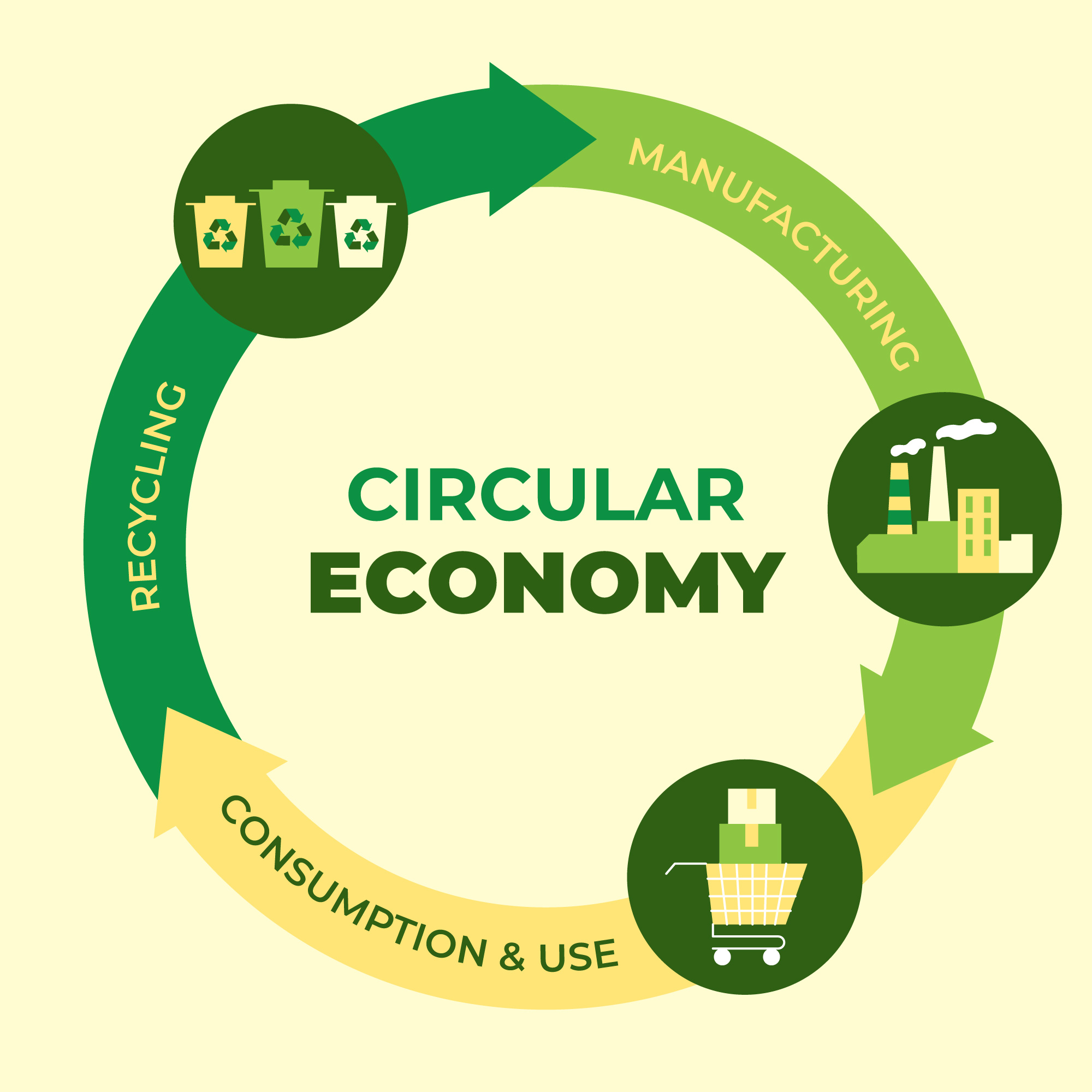
Definition taken from a Google search AI Overview: A circular economy is designed to eliminate waste and regenerate natural systems. Instead of the traditional “take-make-waste” linear model, it keeps materials and products in circulation for as long as possible through sharing, leasing, reusing, repairing, refurbishing, and recycling
If you’re older, the above may ring true from your own past. There was a time when products we purchased simply lasted longer than they do today. The race for upgrades of the latest gadgets all to often mean throwing the old ones away (if they hadn’t broken). This trend is largely responsible for where we are today.
The Ellen MacArthur Foundation has a good article titled The Circular Economy In Detail.
Overview of the Circular Economy
The concept of a circular economy is fairly straight forward. Resources are initially required for manufacturing. Once the product is made, it flows out to the consumer. Our first change is right here because products are built to last and be repaired. This is a crucial first step and will call for a change in perspective as most things these days are throw away. That’s a problem.
To continue, the products above will eventually come to an end of life. Here, instead of winding up in a landfill, products can be disassembled and be recycled back into the manufacturing process . This closes the loop and makes the process circular. However, this is now our second problem, recycling. Forward thinking entrepreneurs should know the recycling industry is projected to hit 1.97 trillion in 2030. You can read about these projections here in waste management and recycling 2026.
For a complete detailed explanation of the circular economy, read what the US EPA had to say in their article titled What is a Circular Economy.
To end the overview I would really like to know where the media is. The circular economy ‘idea’ has been around since 1976. Where’s the reporting? Where’s our updates on how well the world as a whole is doing to prevent environmental crisis? Just makes me wonder.
Timelines
Let’s take a look at some of the existing times and where we’re currently at.
- 2026 – 2030: The regulatory blueprint. This is where we’re at now with EU leading the charge by switching from a voluntary to a mandatory enforcement through their Circular Economy Act. This act aims to double Europe’s circularity rate to 24% by 2030 and also rolls out the Digital Product Passports that track material lifecycle. Globally, more than 70% of manufacturing executives expect circular business models to actively boost their revenues by 2027.
- 2030 – 2035: The Product as a Service tipping point. The projected gains of circular economy solutions will scale past $5.8 trillion driven heavily by advanced chemical recycling plants and automotive closed loop platforms coming online at massive industrial scale.
- 2040 – 2050: The Baseline Norm. This is the projected, realistic window for circularity to become the norm matching up with net-zero climate deadlines. Designing a product without a clear end of life reclamation strategy will not be economically feasible.
Friction Points
Like any large scale global initiative, it’s not without it’s friction points. Some good, some bad.
- The Accelerators:
- Geo-politics: Resources will force nations to look at their own waste streams for critical minerals like lithium, cobalt and rare earth materials) rather than rely on fragile foreign supply chains.
- The Digital Product Passport (DPP): Using blockchain and AI tracking, will give companies absolute transparency over what raw materials are inside a component making automated sorting and recycling actually feasible.
- The Roadblocks:
- Competitiveness Crisis: High energy costs and cheaper subsidized materials overseas have put some recycling sectors into survival mode which slows down domestic investment in infrastructure.
- Infrastructure Gap: Currently we are developing products for circularity faster than we’re building out the physical collection and chemical sorting facilities required to process them.
The above transition is underway. Right now we’re building the necessary framework and this will impact how we shop and manufacture products. The goal is that by 2050 the concept of dump our waste will be an archaic relic of the 20th century.
Upfront Carbon Debt
I wrote previously on how AI is a Catalyst for Change, and it becomes evident with the current path for AI transitioning to fiber optics and photonic chips. Let’s take a look at both of these in more detail.
- Fiber Optics vs Copper:
- The Good: Fiber is made of silicon dioxide (essentially sand), which is infinitely more abundant and far less destructive to mine than copper. A finished fiber cable also has a carbon footprint roughly 6 times lower than an equivalent copper wire length, lasts twice as long (30–40 years), and handles 2,000 times more data.
- The Bad: The manufacturing process for fiber is incredibly electricity-intensive because it requires melting quartz at extreme temperatures. Upfront manufacturing accounts for 70% to 80%
of fiber’s total lifetime emissions.
- Photonic Chips vs Silicon:
- The Good: For AI workloads, photonic accelerators can be thousands of times more energy efficient than traditional silicon chips. Surprisingly, early life-cycle assessments show that the raw fabrication carbon cost per unit area of a photonic chip can be up to 4 times lower than an advanced 28nm electronic CMOS chip because it avoids some of the hyper-complex extreme ultraviolet (EUV) lithography steps.
- The Bad: Photonic chips use specialized compound semiconductors and optical materials. Right now, almost no infrastructure exists to recycle them. If they are thrown away, they end up in general e-waste streams where precious optical components are lost forever.
Bringing fiber and photonic’s to AI will drastically cut the power requirements for data-centers, but the upfront manufacturing costs must be factored. For AI to reduce its resource requirements, the manufacturing process must occur. This manufacturing process must be circular otherwise it’s all for naught. We can’t have it both ways. The technology field is directly tied to the environment and as such, how we do things need to change now.
The Next 10 Years – Danger Ahead
There will be many challenges and opportunities in the switch to full circular economy. However, the biggest danger point is NOW through the year 2035. To make the timelines above, the photonics industry cannot make the same mistakes of the plastics or smartphone industries. The infrastructure around recycling protocols and modular disassembly blueprints need to happen NOW.
The Human Element
Unfortunately it’s not the technology necessary to both improve AI as well as the environment through circularity. The weakest link in the entire cycle are humans.
- Tragedy of the Commons
- The Risk: If US or European tech firms heavily invest in expensive, circular, renewably manufactured photonics, but a competitor elsewhere uses cheap, coal-powered, not recyclable components, market pressures can force a race to the bottom.
- The Fix: This is why the regulatory wave mentioned in our timeline (like import tariffs based on carbon content) is so critical. We can’t rely on human altruism; we have to make compliance the only profitable choice.
- Infrastructure Inertia
- Building a physical infrastructure is much slower than writing computer software. While the math for circularity works, it will take time to build the specialized e-waste recycling plants, train the workforce, update recycling grids, obtaining permits, real-estate and of course physical labor.
Summary
The roadmap and timelines above are mathematically sound and the technology is capable of healing the planet. However, it will take HUMANITY to act like an intentional long term planner, rather than a short term consumer. This really boils down to a high-stakes race against our own habits. We have the tools to win this, but we’re going to have to rely on policy and industrial execution. The bottom line is that it’s going to take people.