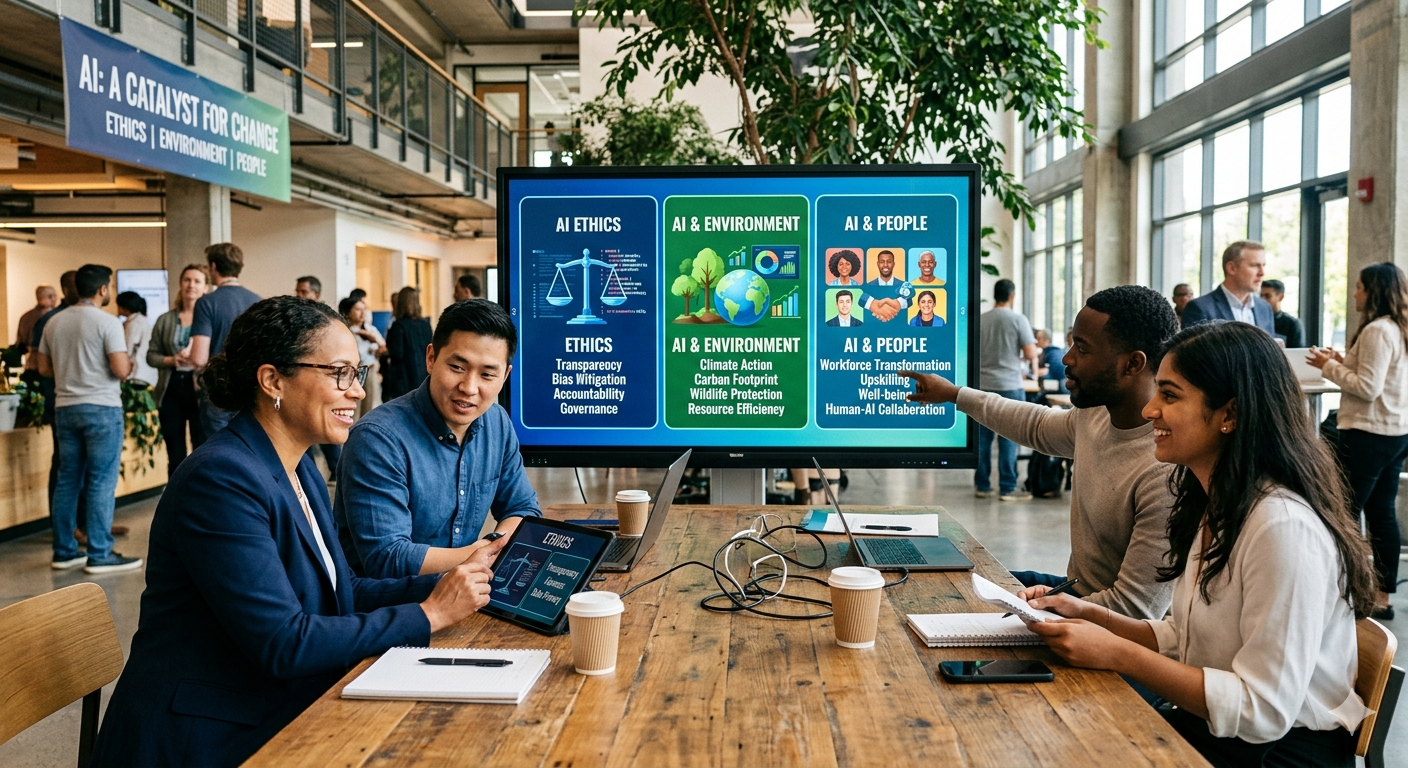
AI is a catalyst for change. Ethics, the environment as well as people themselves. This new era is forcing us to look at ethics, to really being to decompose from the abstract to the practical. The environment continues to be a paradox. Yes, AI requires resources to operate and at the same time is involved in projects to reduce and in some cases eliminate this. Of course nothing will be achieved without people. This is where the biggest challenges lay.
Ethics
Ethics in AI is a requirement now, not at some point in the future. Transparency, bias mitigation, accountability and governance. For more information on my own approach to ethics, check out the articles right here on AI for the 21st Century, ethics category.
- Transparency – Transparency in AI refers to the knowledge around how AI systems operate, make decisions and process data. There are 3 main pillars to this transparency.
- Algorithmic Transparency – This covers the ‘how’ of AI processing. The data used in training and logic to derive a specific conclusion.
- Interaction Transparency – This area is the interaction between the user and AI, how we communicate.
- Social Transparency – This covers not only privacy but the broader impacts to society, our environment, ethics and even potential bias.
- Bias Mitigation – The continuous practice of reviewing the entire process, from data collection and preparation to training and the processing. The intent is to continue to improve the objectivity of the AI to fairly represent all groups and to not favor a privileged group or set of outcomes. Technically speaking this is a complex process. You can read what Science Direct has to say in their article titled: Mitigating Bias in Artificial Intelligence.
- Accountability and Governance – Governance is something I wrote about previously in the article titled Governance vs Architecture. Accountability extends beyond the actual AI. It covers the individuals and organizations responsible for building, training and providing this technology. As AI continues to gain in popularity, so too does accountability and governance gain in importance. You can read what Carnegie Council for Ethics in International Affairs wrote in their article titled AI Accountability. This accountability is monitored or governed through AI governance. The systems of policies and procedures to oversee and monitor AI implementations. Governance is being addressed throughout the world. The UN, EU, Unesco and the WEF (World Economic Forum). Read what the WEF has to say and what their doing today in their article titled, Building Trust In AI Through A New Global Governance Framework.
Environment
AI and the environment is a paradox. On one hand, building out data-centers and the equipment needed for AI also has a negative impact on the environment. However, it’s the very technology we gain that is turned loose on the environment. People, along with AI are working to resolve many issues with our environment.
There are technologies I’ll write about later, like photonic AI that will drastically reduce the power and water requirements. The downside is that this process will also impact the environment negatively in the short term. A circular economy is the end-game and I’ll write about that too in a future article. For some clarity now, photonic AI simply means using photons instead of electrons. This greatly reduces heat which means less water to cool the systems. A circular economy is simply a loop. This approach, currently being researched and implemented worldwide, is the switch between the current model of take-make-waste to a closed loop. The circular economy cuts down on greenhouse gas emissions and decreases toxic impacts of landfills. This is accomplished through recycle and reuse. To see the list of articles I’ve written surrounding AI and the environment, see AI for the 21st Century environment category.
People
The impact to people and jobs is probably the most obvious concern. You can read what I wrote in an article titled, Beyond the Hype: What the Data Actually Says About AI and Jobs by 2030.
In addition jobs, I believe AI and people is our biggest challenge. We’re going to need individuals, corporations and nations to get behind things where we’ve previously failed. One country would prevent deforestation as an example, only to see that process spike in other parts of the world. Our hunger for natural resources is killing our planet. To make matters worse, the products created through these natural resources means money, a LOT of money, for both corporations and nations.
Instead of looking for short-term profit, a longer term plan is required and it needs to be adhered to. This is the only way we can move into a promising future for ourselves as well as our kids and their kids. To get where we need to go, there is going to be a short term negative impact to the environment. However, the byproducts of this short term negative impact will be long term sustainability. It’s almost like saying you gotta spend money to make money. We need to extract and process materials now that will eventually get us to where we need to go. The circular economy as well as AI projects to address the pressing needs of the globe.
Summary
To summarize, AI is our catalyst for change. This one technology is forcing us to address ethics like we’ve never done before, on a global scale. The same can be said for the environment and all of us. It’s going to take both technology and people to make this work. Breaking through technical problems is easier than changing human perspectives, but that’s exactly what we need to do. Should we succeed, we’ll not only improve quality of life, but the environment as well. I see this as similar to the concepts that represent personal and emotional maturity.
- Dependence – This was the time that people lived off the land, entirely dependent on crops, livestock and the weather,
- Independence – I see this as our current stage, where individuals, corporations and even nations are fiercely independent. This race for more, more, more, is lining the pockets of many, but for every ying, there is a yang. For us it’s inequality and destruction of our very home, the globe.
- Interdependence – This is where I see AI taking us. We’re being forced to look at how, exactly, we take the abstract, like ethics and decompose that into actionable steps. Additionally it’s forcing us to see the interconnection of all peoples, corporations and nations with our environment.
It’s time for us all to grow up. Make no doubt about it, we’ve come a long way, but now we’re starting to realize that our approach is just not sustainable. If our ways don’t change and soon, we’ll be addressing one environment crisis after another. There is a different way forward. One where we all work together as one (the globe). Let’s put our national interests aside, at least for the next decade or so. We all need each other and all nations need a place to live, thrive and raise our families. This is the planet earth, our home. It’s time we protect it from ourselves.