After seeing so many articles on how AI is destroying the job market then articles on how AI is exploding the job market by adding more jobs, it’s time to get beyond the hype. Let’s see what the data actually says about AI and jobs projected out to 2030.
By the Numbers
Let’s go beyond the hype and look at what the data actually says about AI and jobs. Current numbers show the following:
- 119,900 direct jobs gained – ITIF (Information Technology & Innovation Foundation)
- 12,700 direct jobs lost – How Automation is Changing US Employment
Note: Unfortunately there is a dark-side called the Entry Level Nuance. Macroeconomic data from Stanford and ADP reveals that while mid-career and senior professionals are keeping their jobs (and using AI to be more productive), companies have significantly pulled back on hiring younger, entry-level workers for AI-exposed roles like software development and junior customer service.
Job Outlook through 2030 – Macroeconomic Projections
World Economic Forum Expectations
| Jobs Displaced | Jobs Created | Net Outlook |
| 92 Million | 170 Million | A projected net increase of 78 million jobs worldwide, as productivity gains generally stimulate broader economic hiring |
| Global Exposure | US Work Hours | Unemployment Impact |
| Roughly 300 Million Jobs | AI has the potential to automate tasks that account for roughly 25% of all work hours in the U.S. | If firms adopt AI gradually over a decade, it is expected to add just a 0.6 percentage point increase to the unemployment rate. However, a rapid, front-loaded corporate rollout would trigger much sharper, sudden labor disruptions |
Where Jobs are Shrinking
Jobs likely to decrease over the next decade are in roles defined by routine information processing, administrative tasks and certain creative industries.
- Financial and Information Services
- Administrative Support
- Entry level white collar (graphic designers, basic writing and entry level programming)
Where Jobs are Gaining
Jobs likely to see an increase over the next decade.
- Infrastructure and power build outs – data-center engineers, hardware specialists and electrical grid technicians.
- Legal and high level strategy – roles requiring critical thinking, relationship management and complex compliance.
- Non-exposed areas – In person physical labor sectors like leisure, hospitality and healthcare/home health aides. These job types remain insulated from AI replacement and will continue to lead job growth.
The Shifting Workplace
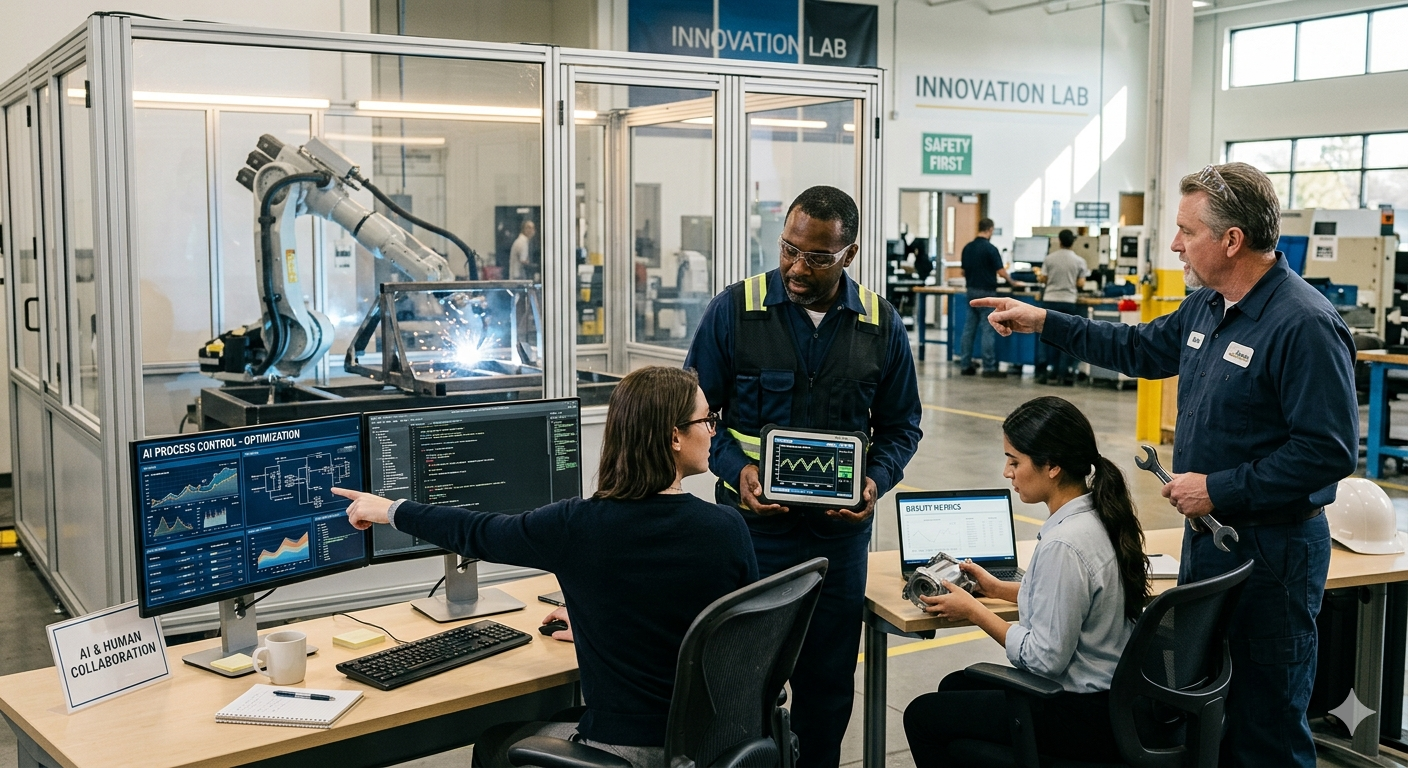
A dominant trend in the workplace is where AI is consider a co-pilot or collaborative partner rather than a replacement. Here’s what the current trends are doing today.
- Shifting from prompting to workflow design – Workers are being trained to use AI as an autonomous assistant or digital intern. This allows workers to begin to use AI to orchestrate multi-step automated workflows.
- Moving away from cheat-able click through modules – This addresses the HR headache of traditional training. Users had used training videos, click through power points, etc. The current trend is towards an interactive, scenario based simulations using AI. The intention is not only the corporate training, but to use AI to solve complex, messy, real-world cases. The training measures critical thinking as well as verification of skill set.
- Internal AI mentorship networks – This is basically peer to peer learning where more experienced employees help guide and train newer employees. This eliminates the need to bring in outside experts for AI training.
- Human in the loop – Here the employees are trained to identify AI hallucinations, biases and factual errors. Additionally, the employee learns when to override the AI algorithm and to implement the soft-skills that AI cannot do. This covers areas like cross-functional collaboration, relationship management and complex ethical judgement.
Blue Collar Jobs Impact
While white-collar workers are figuring out how to prompt text bots, the re-education landscape for blue-collar and factory workers looks entirely different. It is highly physical, fast-paced, and—interestingly—often positions blue-collar workers to gain from the AI boom rather than lose to it.
- Mixed reality and Just-in-Time training – The biggest shift in factory retraining is moving away from classroom manuals and into Augmented and Mixed Reality. Instead of forcing a mechanic to memorize complex new AI-driven machinery protocols, companies are using AR glasses or rugged tablets.
- Transition from operators to system overseers – As factories adopt more smart automation, the demand for traditional assembly-line workers who do repetitive manual tasks is shrinking. However, the demand for industrial technicians is skyrocketing.
- The Amazon model: Upskilling Warehouse Staff to Robotics Tech – Logistics and supply chain companies are facing massive shortages of skilled technical labor. To combat this, companies are building direct, fully-funded bridges from the warehouse floor to the engineering room.
- The blue collar renaissance and trade schools – There is a massive macro trend where Gen Z and younger workers are actively pivoting away from white-collar office tracks (which feel highly exposed to AI automation) and rushing toward skilled physical trades.
Two Very Different Future Scenarios
Gradual Adoption Baseline (probability 75%)
This is the consensus economic “base case.” In this scenario, corporate adoption of AI is steady but slowed down by corporate bureaucracy, legal compliance (like the EU AI Act), data privacy concerns, and the high cost of computing power. In this scenario there is job fluctuations, but not at a critical level. There would be no macro crisis in the job markets.
Front Loaded Friction Crisis (probability 25%)
This is the risk scenario that keeps policymakers awake. A true job crisis happens if AI capabilities experience exponential, compounding breakthrough leaps and corporate deployment happens rapidly all at once. If businesses aggressively roll out agentic AI systems within a compressed 2-to-3-year window to maximize immediate profits, the labor market won’t have time to adapt. This could cause a sudden, sharp spike in unemployment by 2 to 4 percentage points, localized entirely within white-collar knowledge sectors. A corporate analyst or software junior displaced in a sudden wave cannot instantly retrain to become a data center electrical engineer or an HVAC technician overnight. The “skills mismatch” creates a prolonged period of high unemployment for a specific class of educated workers.
Summary
There is a lot of hype around AI and what it will do to our job market. Some insist it will destroy the market (selling fear), others insist it will result in an explosion of new jobs (utopia). The truth is that it’s neither. Regardless of where you are in your career, it does make sense to keep an eye on the trends. You don’t want to be left behind. This is basically what most people do already. If you’re not one of them, I would strongly suggest you start. Talk to others, do a few searches in your area of interests and take a look at the long term trends.