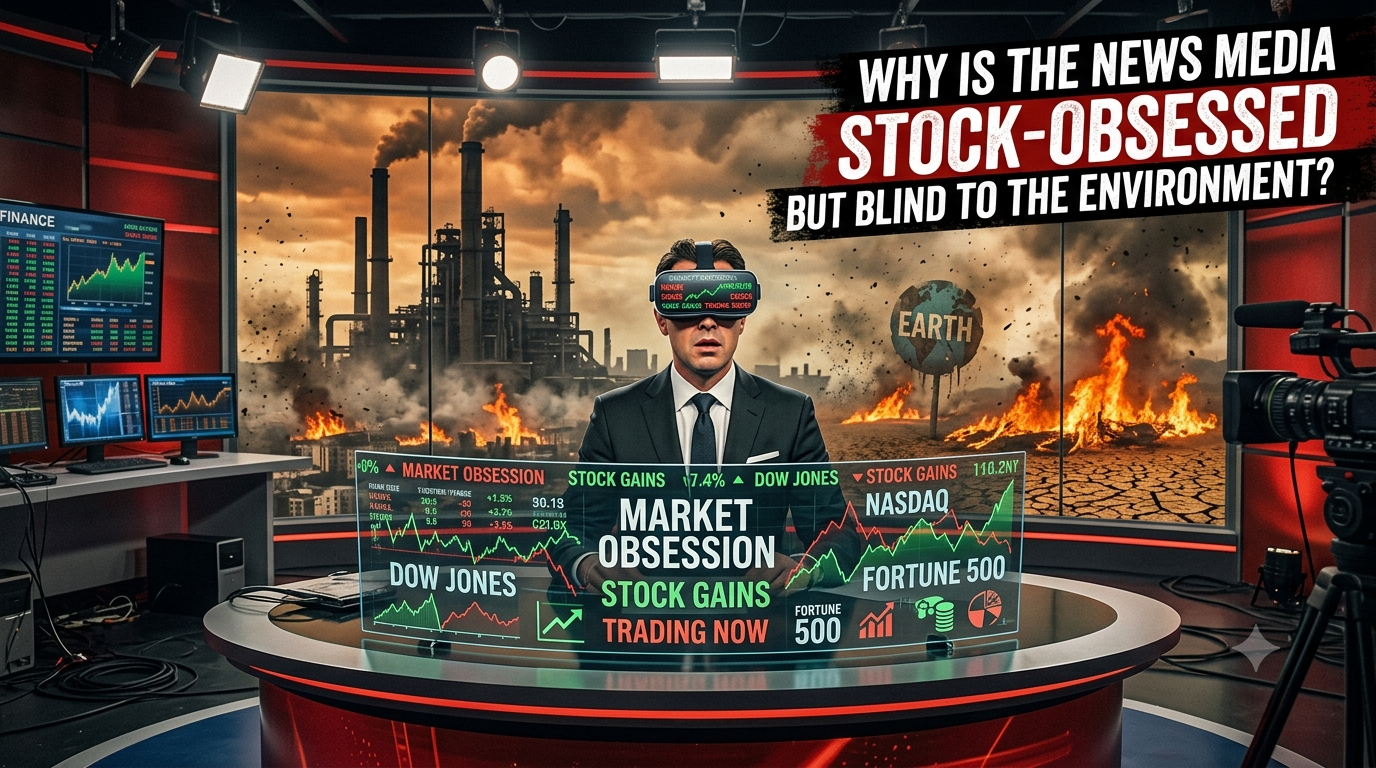
Let’s take a break from AI specifics and turn to the bigger picture. Why is the media so obsessed with the stock market yet blind to the environment? I don’t get this and gotta tell ya, I think it’s a HUGE miss and the media is actually performing a disservice. I’ll get into the details below, but stop for a moment and think about the following.
Stocks? You can turn on multiple cable news programs and get a streaming stock ticker for the S&P and the DOW, to take two examples. The environment? Well, when it comes to the environment, they love to report the ‘event’ (ya know, the crisis) yet fail to report on the trend. (environmental impacts which caused wild fires or the increase in hurricanes, tornadoes, etc) Want to learn about the trend in oil and gas prices? What about technology trends or construction trends? Sure, you can get that and more daily, hourly on the cable news shows. If this doesn’t make you think, ummmmmm, maybe it should?
Let’s start with e-waste since this is an AI blog, then move on to the top 5 environmental issues. We’ll end with where I’d like to see the media take us.
For those interested in AI for the 21st Century articles specifically geared towards the environment, be sure to check out the environment category.
Top 5 e-Waste Companies
Let’s begin with e-waste and who the top 5 companies are causing the biggest impact. To do this, let’s add some context. The environmental watchdogs look at factors such as poor repair-ability, planned obsolescence, reluctance to adopt standard charges and low rates of post consumer recycling.
The list was created with the aid of:
U.S. PIRG Education Fund. This covers things like Annual scorecards evaluating major tech manufacturers (Apple, Samsung, Microsoft, HP, etc.) on repair-ability, access to spare parts, software lockouts, and opposition to Right-to-Repair laws.
IFIXIT which covers live, hands-on hardware tear-downs scoring popular consumer devices on ease of disassembly, glued-in components, proprietary fasteners, and screen/battery serviceability.
GreenPeace which covers environmental benchmark auditing 17 global tech brands on resource circularity, planned obsolescence, toxic chemical elimination, and renewable energy in supply chains..
Here’s The List
- Apple
- Why: Apple has historically drawn intense criticism for anti-repair practices.
- Issues: Proprietary screws, software-locked parts (“part pairing”), and glued-in batteries make repairing devices at home or through independent shops notoriously difficult. This design philosophy frequently encourages consumers to replace whole devices rather than repair them.
- Samsung
- Why: As the world’s largest smartphone manufacturer by volume, Samsung produces a massive annual footprint of consumer electronics.
- Issues: Short software update windows on budget and mid-range devices force hardware retirement long before the physical components fail. Additionally, fragile curved-glass designs and heavily glued battery assemblies make DIY battery replacement dangerous and expensive.
- Amazon
- Why: Amazon creates vast quantities of low-cost, short lifecycle electronics (Tablets, Echo speakers, Kindles and cheap smart-home gear)
- Issues: Because these devices are sold at low price points, repairing them is rarely cost effective. Furthermore, undercover investigations by news outlets (such as ITV News) have caught Amazon fulfillment centers routinely destroying millions of unsold or returned electronic items to clear warehouse space.
- Microsoft
- Why: While Microsoft produces hardware like the Surface line, their software decisions heavily drive global e-waste.
- Issues: Hardware requirements for Windows 11 (specifically mandatory TPM 2.0 chips and newer processor generations) officially rendered hundreds of millions of functional PCs incapable of upgrading from Windows 10. Environmental groups warned this single software policy shift risks creating unprecedented amounts of premature PC e-waste worldwide.
- HP (Hewlett-Packard)
- Why: Printer and PC manufacturers are infamous for disposable hardware models, and HP is a frequent target for consumer advocates.
- Issues: Dynamic Security firmware updates block third-party or refilled ink cartridges, driving unnecessary plastic and chip waste. Moreover, entry-level laptops are frequently built with non upgradable, soldered RAM and storage, ensuring the entire machine ends up in a landfill once hardware needs grow.
It’s Not Just Companies, But Countries
It’s worth noting that e-waste isn’t just about manufacturer design—it’s also driven by illegal exporting and informal dumping. Much of the world’s discarded hardware ends up in unregulated scrap hubs like Agbogbloshie in Ghana or informal dismantling yards in India and Nigeria, where
workers burn electronics to extract heavy metals, causing severe toxic exposure.
Let’s take a broader look at e-waste at the international level.
When examining the world’s top e-waste generating countries, environmental analysts look at two main metrics: total gross volume (the total weight of discarded electronics) and per capita generation (the average e-waste created per person).
To rank counties e-waste, specifically total gross volume check out The Roundup in their article titled: The Global E-Waste Statistics and What They Tell Us.
Top 5 e-Waste Countries by Total Volume
| Country | Annual E-Waste | Key Drivers |
| China | 12.0 Million Tons | Worlds largest population of smartphone/gadget consumers and a major hub for electronics manufacturing. |
| United States | 7.0 Million Tons | High consumer purchasing power, short device upgrade cycles, and low national repair rates. |
| India | 3.2 Million Tons | A rapidly expanding middle class and massive adoption of personal electronics, though recycling remains largely informal. |
| Japan | 2.5 Million Tons | High density of consumer appliances and personal technology, offset somewhat by a formal recycling infrastructure. |
| Brazil | 2.1 Million Tons | The largest consumer market in Latin America, but hampered by low formal collection and recycling infrastructure. |
Top 5 e-Waste Countries Per Capita
| Country | Annual E-Waste | Key Drivers |
| Norway | ~27kg per person | Leads the world in per-capita electronic waste. However, Norway also boasts one of the world’s most efficient formal collection and recycling programs (~72% collection rate). |
| United Kingdom | ~24kg per person | High demand for consumer tech and home appliances, with consumer groups citing rapid obsolescence as a major issue. |
| Switzerland | ~23kg per person | High per-capita wealth leads to frequent device upgrades, though backed by strict recycling mandates. |
| France | ~22kg per person | Significant domestic appliance turn-over, leading France to introduce a pioneer “Repair-ability Index” law to curb waste. |
| Iceland | ~22kg per person | High reliance on personal electronics combined with a small population distorts its per-capita numbers. |
Note: 1kg is 2.204623 lbs.
According to the UN Global E-Waste Monitor, global e-waste generation is rising five times faster than documented recycling efforts. While wealthy Western nations generate the most e-waste per person, a substantial portion of that discarded hardware is historically exported—often illegally—to developing nations in West Africa and Asia with fewer environmental protections.
Top 5 Environmental Issues
Here’s an interesting tidbit of information. As bad as e-waste appears above, it doesn’t even crack the top 5 overall environment issues.
Details for the list were extracted from Earth.org, the World Economic Forum, and the United Nations Environment Program.
| Climate Change Acceleration & Extreme Weather | Global average temperatures continue to hover near critical tipping thresholds, driven by greenhouse gas emissions from fossil fuel burning and industrial activity. This acceleration manifests as intensified heatwaves, prolonged megadroughts, severe flooding, and unpredictable agricultural seasons worldwide. |
| Biodiversity Loss & Ecosystem Collapse | Often described alongside climate change as a twin crisis, habitat destruction, ocean acidification, and climate stress are driving rapid species decline. Key ecosystems—including coral reefs, wetlands, and rainforests—face severe degradation, threatening natural carbon sinks and vital natural systems like crop pollination. |
| Pollution & Waste Management | Plastic pollution, microplastics, chemical runoff, and ambient air pollution remain widespread hazards. Millions of tons of mismanaged plastic waste enter terrestrial and marine environments annually, while industrial emissions and agricultural pesticides contaminate critical air and freshwater sources. |
| Water Scarcity & Freshwater Stress | Intensifying droughts, over-extraction of groundwater, and water pollution have elevated water stress into a major geopolitical and economic threat. Major agricultural basins and urban centers face critical freshwater shortages, impacting public health, food production, and energy grids. |
| Deforestation & Land Degradation | Agricultural expansion, commercial logging, and mining continue to drive large-scale forest loss in critical carbon sinks like the Amazon and Congo Basin. Topsoil erosion and soil degradation occur at rates far faster than natural replenishment, diminishing land productivity and accelerating desertification. |
Wait, What?
If you’ve read this far you may be asking yourself, wait, what? How, did this happen? What’s going on with the environment? Why don’t’ I hear about this on the news? What the hell is going on!!!!!!
If you thought those or similar things, you’re not alone. Remember how we started out? The question around why does the media bombard us with stock ticker and financial information all day everyday across the cable news? Why is it we can more easily obtain information on industry trends then our own environment?
It doesn’t matter where you live. The truth is we all live on one big beautiful blue marble. Well, that beautiful shade of blue is dimming. This is a call to all the media outlets to step up. Educate, inform, get your reputation back. Quit avoiding the companies that feed your revenue streams. Stop dancing around powerful corporations and do what you used to do best. Be that hard hitting investigative journalist you dreamed about. We need you now to get the world out.
Let’s take a look at some ideas I have and how exactly that can be done.
3 Ways The Media Can Educate and Inform
Let’s start out with my favorite and why I titled this article the way I did.
1. The Daily Ticker: Financial Markets vs Earth’s Balance Sheet
Cable news and finance outlets run a constant real-time ticker for stock indexes (S&P 500, NASDAQ) and currency fluctuations. However, they ignore the physical assets that make an economy possible.
How about we add a planetary ticker right along side this!! Here’s what I mean:
| Financial | Planetary | Trend |
| Tech Stocks Rally | Global Aquifer Drawdown rates | Major agricultural basins running dry within 10-15 years. |
| Quarterly Consumer Spending | Topsoil Loss | Approximately 50-60 harvests remaining before widespread yields fail. |
| Oil and Gas Earnings Report | Remaining Carbon / Heat Budget | Irreversible ecological tipping points triggered between 2030 and 2040. |
See what I mean? That could work. Get the information out there. Educate and inform. Get all those cable news stations talking about this.
2. Name the Structural Actors (Countries and Corporations)
Here I propose splitting into three clear categories.
- The Linear Economy Drivers (The Throwaway Model)
- Who: Fast-fashion conglomerates (e.g., Shein, Inditex), single-use packaging giants, and low-cost hardware manufacturers.
- Media Adjustment: The press routinely covers these companies as “retail success stories” or “supply chain marvels” while completely ignoring the volume of non-recyclable waste they dump into the global economy every 24 hours.
- The Sovereign Extractor Nations
- Who: Top per-capita waste and extraction countries (e.g., the U.S., Canada, Australia, Gulf States) alongside high-volume manufacturing hubs (China, India).
- Media Adjustment: Geopolitical coverage focuses heavily on military spending and trade tariffs, but rarely evaluates national power by a country’s stewardship of shared global commons (aquifers, atmosphere, biosphere integrity).
- The Regulatory Watchdogs Sleeping On The Job
- Who: International regulatory bodies and domestic agencies (like the US EPA or EU regulators) that allow “novel entities” (plastics, PFAS, synthetic chemicals) to be commercialized long before safety and circularity testing are performed.
- Media Adjustment: The media typically hypes what’s coming and which companies are spearheading development and implementation. Dig deeper. Don’t shy away from regulatory watchdogs, go after them just as you would financial fraud.
3. Editorial Hooks Journalists Can Use Today
- The Silence on the 7th Boundary
- Pitch: Scientists track the 9 Planetary Boundaries—the environmental thresholds that keep Earth habitable for human civilization. Seven of those nine boundaries are now officially breached (including freshwater change, ocean acidification and land use alteration.
- Call Out: Why did the crossing of the 7th Planetary Boundary get less airtime than a single day of tech stock earnings?
- Event Based vs Trend Based Journalism
- Pitch: The media only reports on environmental collapse when it manifests as a sudden disaster (a wildfire, a massive flood, or a heatwave).
- Call Out: Disasters are symptoms; systemic depletion is the disease. By reporting only the smoke and never the fuel, news outlets hide the timeline from the public.
- The Convenience Cover Up
- Pitch: The throwaway economy was built decades ago on the promise of “cheap consumer convenience” (disposable plastics, planned obsolescence, single-use goods).
- Call Out: Name the ad-supported media model itself: major news networks rely on advertising revenue from the very corporations driving this throwaway culture, creating an inherent conflict of interest.
- Where is the Daily Earth Dashboard?
- Pitch: Challenge major news organizations (BBC, NYT, CNN, Reuters) directly.
- Call Out: Propose that every major newsroom establish a dedicated “Planetary Health Desk”—not a niche climate blog buried in the lifestyle section, but a front-page daily metric system that tracks resource depletion, pollution thresholds, and circularity efforts alongside international news.
Summary
The time to play nice is quickly running out. Now more than ever we need the media to educate and inform. Let the public know the throw away economy needs to end now. Just don’t tell us, show us, daily. Identify the worst polluters by corporation and country. Give us those ticker symbols so we can monitor how close we are to crisis. Don’t just report on the event, report on the trend. This is no different than reporting on industry trends for current or future investors. This environmental trend aids in our investment for the future, not the next quarterly dividend.
On a personal note, I find this lack of reporting so dangerous that I’d like to ask you to share the link to this article. Whether your friends are in the media or not, let them know. Get the word out that we need to become much better stewards of the planet. Time is running out.