Today we’re going to dive into the secret formula on how to write better AI prompts. No coding required!
Hey everyone, welcome back to the blog!
If you’ve spent any time playing around with AI tools lately, you’ve probably realized something pretty quickly. Sometimes you ask an AI a question and get a brilliant, mind blowing response. Other times, it gives you something so generic, boring, or flat-out wrong that you wonder if it even understood English.
The difference usually isn’t the AI. It’s the prompt—the instructions you gave it.
Think of AI like a brilliantly talented, hyper-knowledgeable intern who has read almost every book and website on earth, but has zero common sense and absolutely no context about who you are or what you actually want. If you tell an intern, “Write a report on marketing,” you’re going to get a messy, generalized document that isn’t helpful. But if you tell them, “Write a two-page summary of email marketing trends for 2026, specifically focused on small coffee shops, written in a casual tone,” you’re going to get exactly what you need. Writing a great prompt isn’t about knowing how to code. It’s about communication. Today, we’re breaking down the simple, non-technical framework to write prompts that get amazing results every single time.
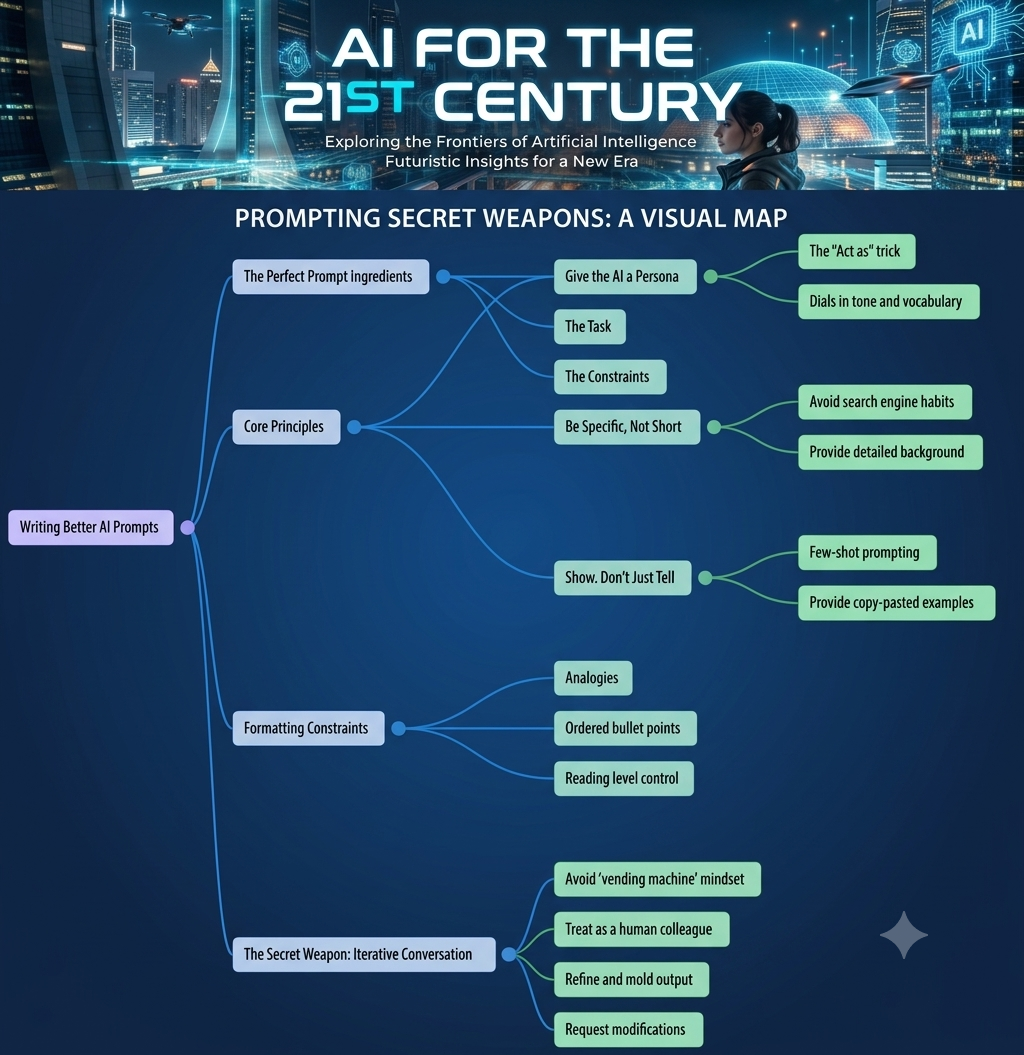
The Recipe for the Perfect Prompt
You don’t need a computer science degree to talk to AI, you just need a recipe. The best prompts usually contain four main ingredients. You don’t always need all four, but the more you include, the better your results will be.
Ingredients for the Perfect AI Prompt
- The Role – Who is the AI pretending to be?
- The Task – What do you actually want it to do?
- The Context – What is the background or hidden details?
- The Constraints – What are the boundaries, tone or format?
Let’s take a look at an example to see how using the ingredients above completely changes the game.
| The Google Search | Better AI Prompt |
| Give me a workout plan | [Role] Act as a certified personal trainer specializing in beginners. [Task] Create a 3-day weekly workout plan. [Context] I am a 35 year old who works a desk job, has minor lower back pain and only has dumbbells at home. [Constraint] Keep workouts under 30 minutes and format the output in a clean tabular way. |
Note: You don’t need to input the words in [] above.
Go ahead and try above in your favorite AI chatbot. Do you see the difference? The first prompt forces AI to guess what you want. The second prompt gives a clear roadmap.
Core Principles for How to Write Better AI Prompts
To master this without getting bogged down in technical jargon, just keep the following three simple rules in mind when you’re typing into the chat box.
1. Give The AI a Persona (The “Act as” Trick)
AI models are massive webs of information. If you just ask a generic question, it pulls from a generic pool of data. By telling the AI to pretend to be someone specific, you instantly force it to filter its knowledge through that lens. Need financial advice explained? Tell it to “Act as a friendly, patient financial advisor explaining things to a teenager.” Need a recipe? Tell it to “Act as a zero-waste chef who specializes in using leftovers.”
Giving it a persona instantly dials in the tone, vocabulary, and perspective of the response.
2. Be Specific, Not Short
When we use search engines like Google, we are trained to use as few words as possible (e.g., “best travel shoes”). But AI is a conversational partner. It thrives on detail.
| Instead of Asking | Try Using This |
| How do I fix a leaky faucet? | I have a standard double-handle bathroom sink faucet that is dripping from the spout about once every two seconds. I have basic tools like a screwdriver and a wrench, but no plumbing experience. Can you give me a step by step guide to figure out what’s wrong and fix it? |
It takes an extra 20 seconds or so to type, but it saves you 20 minutes of filtering through generic advice that doesn’t apply to your specific sink.
3. Show, Don’t Just Tell (Few Shot Prompting)
If you want the AI to write something in a very specific style—like an email that sounds exactly like you, or a product description that matches your brand—the easiest thing to do is give it an example. In the tech world, they call this “few-shot prompting,” but out here in the real world, we just call it “copy-pasting an example.”
Try a structure like this:
- I want to write a weekly newsletter update for my clothing store. Here is an example of a newsletter I wrote last week that my customers loved: (Paste your old newsletter here) Now, using that exact same friendly, punchy tone, write a new update about our upcoming summer clearance sale.
Handy Formatting Constraints You Can Use
One of the coolest things about AI is that it doesn’t just have to output giant walls of text. You can command it to organize information in ways that make your life incredibly easy. At the end of your prompt, always specify how you want the answer delivered. Here are some great constraints to add to your prompts:
- Format this as a table with columns for Pro’s, Con’s and Costs
- Explain this in a single paragraph, using an analogy about cooking
- Give me the answer in 5 bullet points, ordered from the most important to least important.
- Write this at a 5th grade reading level, avoiding all corporate buzzwords
The Secret Weapon: The Iterative Conversation
Here is the biggest mistake people make: they treat the AI like a vending machine. They put a prompt in, get a response they don’t love, and walk away thinking, “Well, AI sucks.” Instead, treat it like a conversation! If the AI gives you a response that is 70% of the way there, don’t start over with a brand new prompt. Just talk to it like a human colleague.
- That’s a good start, but make the tone a bit more exciting
- Can you remove option #3 and expand on option #2 with more detail?
- Great, now rewrite that entire thing but make it short enough to fit into a tweet.
You can keep refining and molding the output until it’s absolutely perfect.
Summary
At the end of the day, prompt engineering isn’t a math problem—it’s a communication skill. The more clear, vivid, and structured you are with your thoughts, the more magical the AI’s response will be. Next time you open up your favorite AI tool, step away from the short, robotic search queries.
Take a breath, give the AI a job, lay out the details, and watch how much smarter it suddenly seems.
While above gets you better prompts today, if you like, feel free to deep dive the topic over at MIT Management in their article titled Effective prompts for AI: The Essentials.
Happy prompting, and let me know in the comments below what prompts worked best for you this week.
Here’s a cool, easy to follow mind map for the Secret Formula to Writing Better AI Prompts.