Part 3: Output
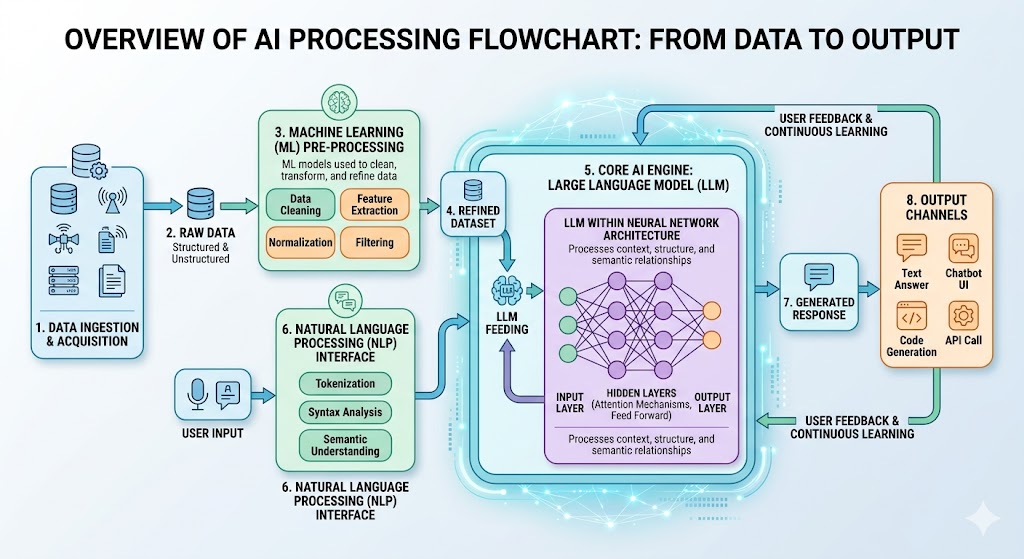
We’ve arrived at the output. What you and I can see once the AI has processed our requests. The output not only consists of the generated response, but also shows a variety of output channels, or where the output gets routed to. What I like most about this flow is it’s iterative nature.
Iterative Process
The user feedback acts as a way for the AI to continuously learn. This is far different from what we’re used to in the past. In the past the output was evaluated, then resubmitted back to IT for tweaks or to obtain clarity. This is where AI shines. It can take immediate feedback and loop back into it’s processing mode, generating a new response. This can occur over and over in real time.
Output Channels
As you can see, the output channels are varied. It could be a text response while chatting with your AI assistant. It could be an API call which means application programming interface. This is a fancy way of saying allowing one program to communicate back and forth with another. We also see something call code generation. Yes, the technical programmers may or may not like this, but the AI can produce usable program code. This greatly reduces time to market for new software applications, or for fixing bugs in existing applications.
Generated Output
Finally, let’s look at that generated response. This can be a picture, graph, spreadsheet, even music. When working with complex data in the response, this generated format can help communicate the relationship between data in a more user friendly manner. This process could also expedite understanding the data. Whether it be sales figures, investment strategy or home budget what-if scenarios. Humans need to interpret, understand and implement data in usable, actionable ways. The output or generated response helps to expedite that process.
Conclusion
Congratulations, you’ve completed the 3 part article on the flow of AI processing. We left out a lot of the complexity, the math. For now, understanding the flow is a huge step forward. We can take some comfort in knowing how data is prepared for the AI. How that data is processed and presented to us.