Part 2 : Processing
We’ll now take a look at part 2. Processing. It’s very easy to get lost in the complexity of what occurs here. I promised to keep my articles high level. This is no exception. To learn more about the mathematics involved, there are plenty of web-sites and books you can dive into. You could even go to your favorite generative AI. My intent is geared around explaining flow. Let’s do that now and take a high level look at neural networks.
Neural Networks
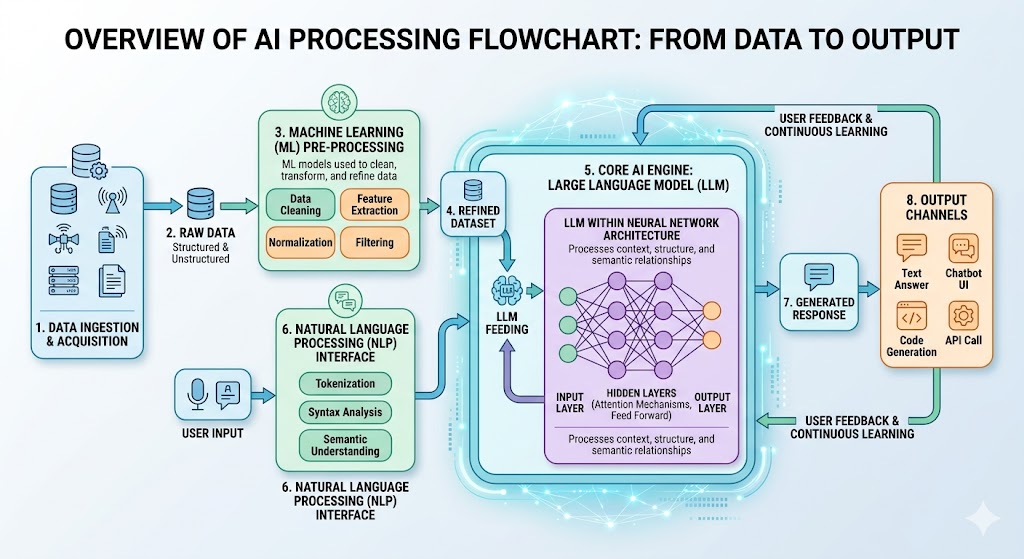
More magic occurs here, within the neural network. The brain of our AI. Remember the basic flow from part 1 on input? The neural network follows the same flow. Input, processing and output.
- Input
- Hidden Layers (processing)
- Output layer
Inside our neural network, you will see a new component on the left hand side. Let’s introduce that now.
New Component
As you can see from the diagram at the top of this article, an LLM or large language model is the new component of the neural network. Regardless of where and how our input was derived, it flows into this new component. The LLM is what then feeds the input component of the neural network. This is generative AI using an LLM. Best way I can sum it up is that not all AI neural networks contain an LLM, but all LLM’s are implemented within an AI neural network.
Input
All our original data, prepped. Raw or user inputted, this data enters our LLM which feeds into our processing.
Hidden Layer (Processing)
Nodes, or artificial neurons as it’s called, transforms the input. This is where some more of that magic occurs. Through a variety of mathematical calculations, weights and biases, it flows between the different nodes or neurons within our hidden layers. For the sake of simplicity, we won’t cover the math involved here. This processing from node to node follows a linear transformation from the input to output.
Output
The output itself goes through another round of algorithms and mathematics.The process enriches the output further to generate a final predication or outcome.
Wrap Up
This is very high level and doesn’t even touch on the complexities of the algorithms and high level math being carried out. That’s on purpose. I myself don’t really understand all the math and algorithms, but that doesn’t prevent me from using AI. I couldn’t strip down my cars engine and rebuild it, but that doesn’t stop me from driving a car!
Understanding the flow can be difficult, but worth the effort to understand. Regardless of what you ask generative AI to do, the above flow is followed. Further, if you have plans to enter this field or you want to understand it at a deeper level, look to the flow. Where in the flow are you most interested? Is it the acquisition of data, training the data, learning how to parse out language from speech or text? Maybe you’re really into the math and want to focus on the linear transformations, the weights and biases. If you’re more interested on the presentation of the response, maybe your area of study is the output. I’ll cover that in the final part of this three part series on AI technical flow.
Congratulations
Congratulations. You’ve made it through part 2. I hope you have a better understanding of the flow of AI processing. Did you detect the underlying similarities between non-AI related flow and the flow of AI? Looks familiar doesn’t it? Like most inventions, AI is built on top of existing knowledge and improved. Think of the car you drive. The basics of a model T can be found in our modern cars of today. Just a lot more advanced. The same can be said for trains, telephones, etc. This is yet another progression, the next step in the development of our technology.