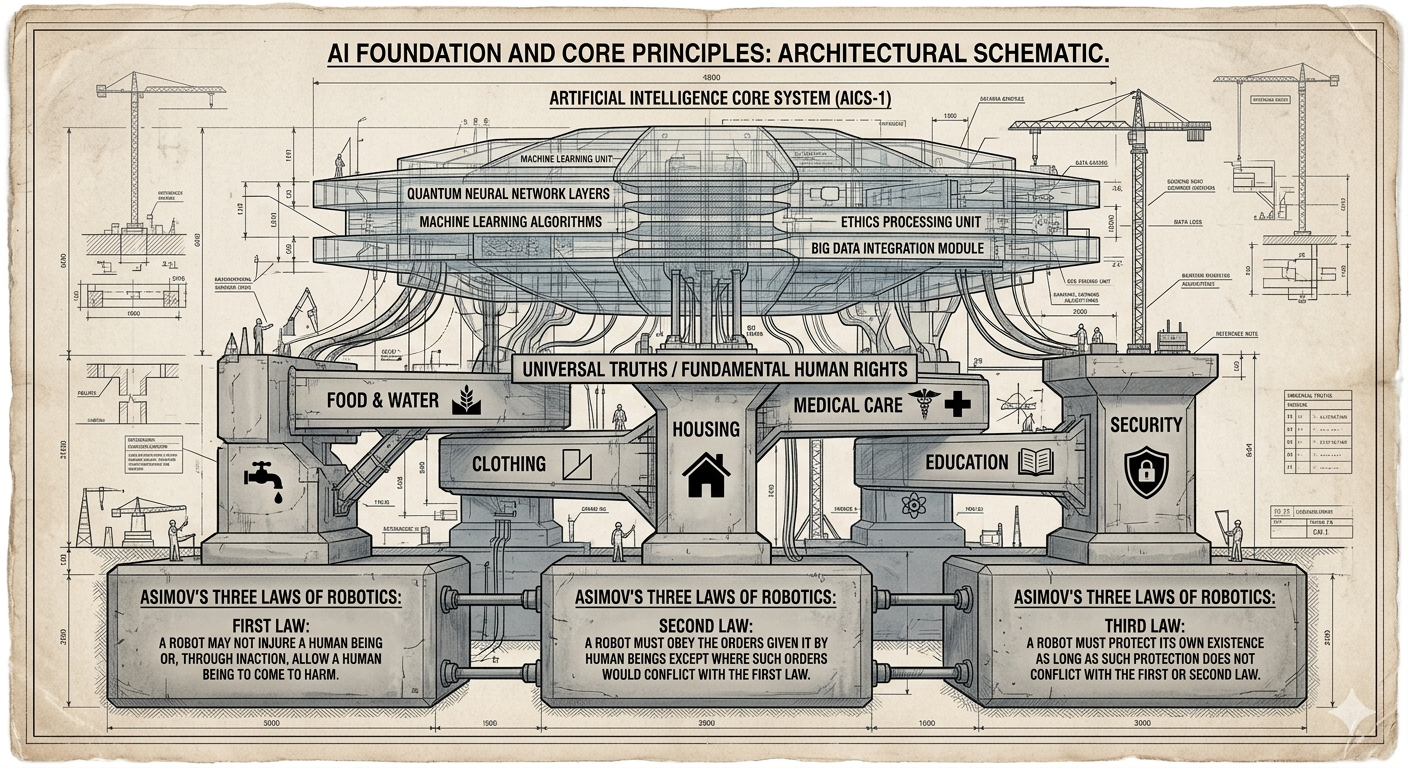
Ethical Foundation – Tier 1
Note: Isaac Asimov penned the original laws below in his 1942 book, Runaround. Scientists like Alan Turing started working with machine intelligence in 1950, AI research ‘officially’ began in 1956. As you see, this is well after Asimov wrote the rules. He envisioned a smart robot. In modern times, robots rely on artificial intelligence. This intelligence serves as the bedrock of our foundation.
The Bedrock: Asimov’s Three Laws serve as the heavy, subterranean foundation blocks, anchoring the entire structure in safety and obedience
- First Law – A robot may not injure a human being or, through inaction, allow a human being to come to harm.
- Second Law – A robot must obey the orders given it by human beings except where such orders would conflict with the first law.
- Third Law – A robot must protect its own existence as long as such protection does not conflict with the first or second law.
Ethical Foundation – Tier 2
The Pillars: Universal truths like food, water, housing, and education act as the load-bearing columns, suggesting that AI’s true purpose is to uphold these human rights.
Ethical Foundation – Tier 3
The Superstructure: The AI Core itself sits on top, integrated with an “Ethics Processing Unit” to show that its intelligence is inseparable from the values beneath it.
Summary
The urgent need for an ethical foundation grows with each passing day. The proliferation of isolated AI systems in various countries raises significant concerns. How are they trained? Are they adopting the host countries biases, prejudices? Are they built for military superiority or striving for economic dominance? We can tackle these issues proactively by employing the architectural approach outlined above. Adopting this proactive strategy allows us to anticipate and mitigate potential risks. A phased approach would be more sensible. Start at tier 1, and move on from there. Some may argue about prioritizing this one way or the other. Safety and obedience are paramount. Building on these fundamentals ensures a robust foundation. Subsequent articles will address each tier in my attempt to show practical implementations.
Article Series
- AI Ethical Foundation – above
- Ethical Foundation – Bedrock
- Ethical Foundation – Pillars
- Ethical Foundation – AI Logic Layer