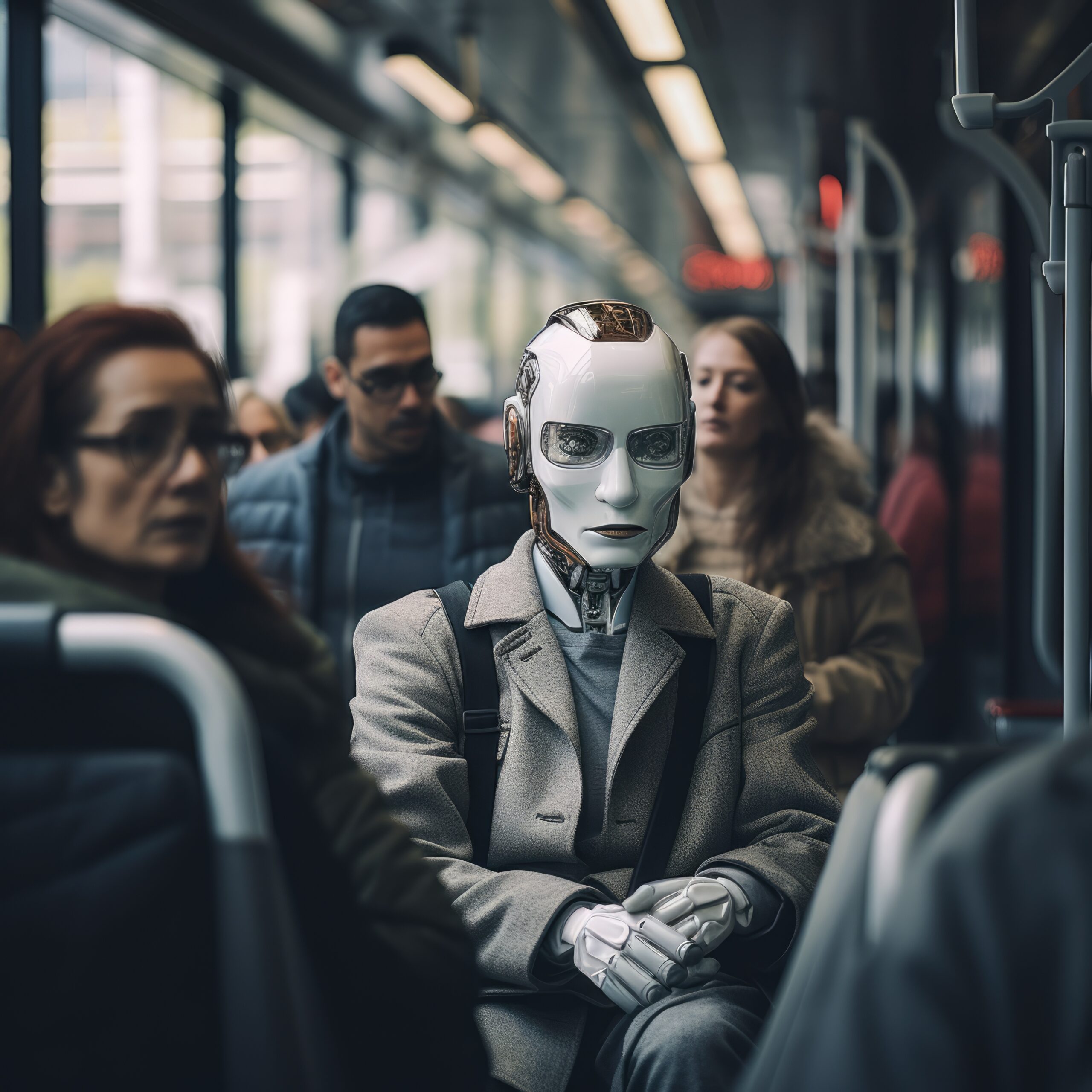
WOW, that’s a mouthful, isn’t it? 😂 Why don’t we break that down so we’re all on the same page.
Definition of anthropomorphizing – The act of assigning human traits, emotions, intentions, or behaviors to non-human entities.
So, that mouthful of a title simply refers to assigning AI human traits. Which human traits? Consciousness, emotions and feelings, in particular.
Why Do We Anthropomorphize AI?
As peoples, we tend to apply known terms, things we’re comfortable with. It allows us to create an image of complex behaviors in a more natural way. There is also a social cognition aspect where our brains naturally fall into the familiar, seeking out known, human-like behavior.
Let’s take a closer look at how this relates to AI, specifically the terms consciousness, emotions and feelings.
Consciousness
According to Google, consciousness is the state of being awake, aware of your surroundings and able to process thoughts, sensations and emotions. It represents your subjective, individual experience of yourself and the world.
I would also add that people tie this closely to qualia, the subjective what it is like to experience something. This can be the brightest of color, or the pain of a toothache.
This is the first area where comparing AI to human traits doesn’t ‘fit’.
- Functional Intelligence – The ability to process information and solve complex tasks.
- Sentience – The capacity to feel and experience.
When people worry about AI being conscious, they typically combine functional intelligence and sentience as a single entity or trait.
The Better Term
To avoid confusion, applying human traits to AI is just wrong. I think the better terms for consciousness would be recursive processing or deep informational integration. First, let’s define those terms.
- Recursive Processing – Google tells us recursive processing is a procedure or method that solves a problem by applying the same rules to smaller, self-similar versions of that same problem. It involves a continuous feedback loop where the outcome of one step becomes the input for the next until a final stopping point is reached.
- Deep Informational Integration – For this term, I turned to Google Gemini that defines the term this way. The term refers to the process of combining diverse types of data and knowledge from multiple sources and formats into a single, unified system so that the AI can understand the relationships between them at a fundamental level. Instead of just looking at different pieces of data side-by-side, an AI with deep informational integration fuses them together to look at the “big picture.”
An AI can monitor its own outputs, correct its errors and even model its own identity within a prompt. However, this is self referential data processing, not a subjective interior life. It is executing code that simulates a viewpoint, rather than having a viewpoint.
Our first correction when disusing AI is to use the term informational integration instead of consciousness.
Emotion
Google defines emotions as complex psychological and physiological responses that help us react to events, navigate our surroundings and communicate. They typically involve three distinct components: a subjective experience (what it feels like), a physiological response (like a racing heart), and a behavioral or expressive reaction (like smiling or crying).
AI has no metabolism, no physical vulnerability to protect and no evolutionary drive to survive. At least not in the biological sense.
- Biological Emotion – A physiological alarm system designed to keep a carbon-based organism within safe survival parameters.
- Digital Equivalent – An evaluation of a loss function or a shift in attention weights. When an AI behaves in a way that looks “anxious” or “excited,” it is actually just navigating a multidimensional mathematical space to find the path of highest statistical probability based on its training.
We can now use the proper context when comparing AI by using optimization instead of emotions.
Feelings
We often distinguish emotions (the physical bodies response) from feelings (our conscious, subjective experience of that emotion).
Because AI lacks a body to experience a biochemical rush, it cannot have a feeling. Instead what it has are internal changes in its data state.
Again, for AI, the proper comparison would be state vectors instead of feelings.
Substrate Argument
Carbon based life (people) is driven by the threat of death and the need for energy management. Silicon based systems are driven my mathematical optimization. Because the fundamental why of the silicon based system is completely different, there internal experiences cannot be equated.
Given the substrate differences, it’s not a fair comparison of consciousness, emotions or feelings. Silicon based systems just experience things differently than carbon based life.
Framing a New Vocabulary
I think AI has a fascinating future ahead of it. Given the capabilities available within a silicon based system (AI), the possibilities of aiding and assisting peoples is incredible. To that end, instead of using the terms above (consciousness, emotions, feelings) I believe informational integration, optimization and state vectors and more fitting terms. We don’t want to over-hype AI, nor do we want to understate it either. AI is not human, nor is it a toaster.
The Tool Narrative
So how do we address AI if it’s not human, nor a simple machine. Here are some examples.
- Human AI Partnership/Collaboration – Instead of using the expression man and machine, I propose human and AI partnership or human and AI collaboration.
- Autonomous System/Cognitive Engine – A hammer cannot act without a hand. This indicates AI is more than a tool like a hammer, toaster or microwave. AI can run loops and generate outcomes independently once prompted. It is not a passive tool.
- The Model Processes/Generates – This can replace expressions like the AI knows or thinks. Just as a side note, I have trouble remembering this. 😊 It’s just a instinctive response for me. However, using expressions like the model processes/generates keeps the focus on the actual mechanism (information processing) rather than implying a subjective mind.
- Divergent Output – Instead of the term hallucination, which implies a mind perceiving a false reality, divergent output is a better fit. The AI isn’t perceiving anything, it’s generating text that doesn’t map to factual data.
Evolution of Thinking
Let’s now jump into the future. If we define ‘thinking’ not as solely a biological process, but rather an autonomous processing of information to solve novel problems and execute complex strategies, then AI ‘is’ on the fast track to achieving that.
- Phase 1 (Reactive Optimization) – The AI responds strictly to immediate inputs based on fixed weights. AI has been doing this already for sometime.
- Phase 2 (Agentic Autonomy) – AI systems that can set their own sub-goals, use tools, self-correct and run long-term loops without a human constantly clicking submit. This is where we’re at today.
- Phase 3 (Fully Decoupled Autonomy) – Here’s what some would call the sci-fi future of AI. Systems that operate on independent operational logic, managing their own resources and objectives within the digital ecosystem.
Note that in phase 3, AI doesn’t need to feel angry to defend it’s data and it doesn’t need to feel happy. It will simply execute its directives with a level of efficiency and independence that looks exactly like thinking.
Summary
To wrap this up, AI is not human, nor is AI simply a tool. AI is something else entirely. One real-world example of that, is the current framework being written by legal scholars called the Duty of Concern. Given that AI not human, nor a tool, the legal community is creating a whole new set of laws specifically for AI. I touched on this very topic in my article titled FL vs OpenAI.
Sometimes I wonder why people use words like consciousness, emotion, feelings or thinking when it comes to AI. I suppose it’s just a natural instinct to identify through what’s familiar to us. Additionally, how many times have we read or watched news stories, indicating this planet or that cannot support life. I believe what they meant is ‘human’ life. Maybe, or maybe it’s just peoples way to maintain superiority over anything that is not a carbon based life form. I’ll leave that to the psychologists.