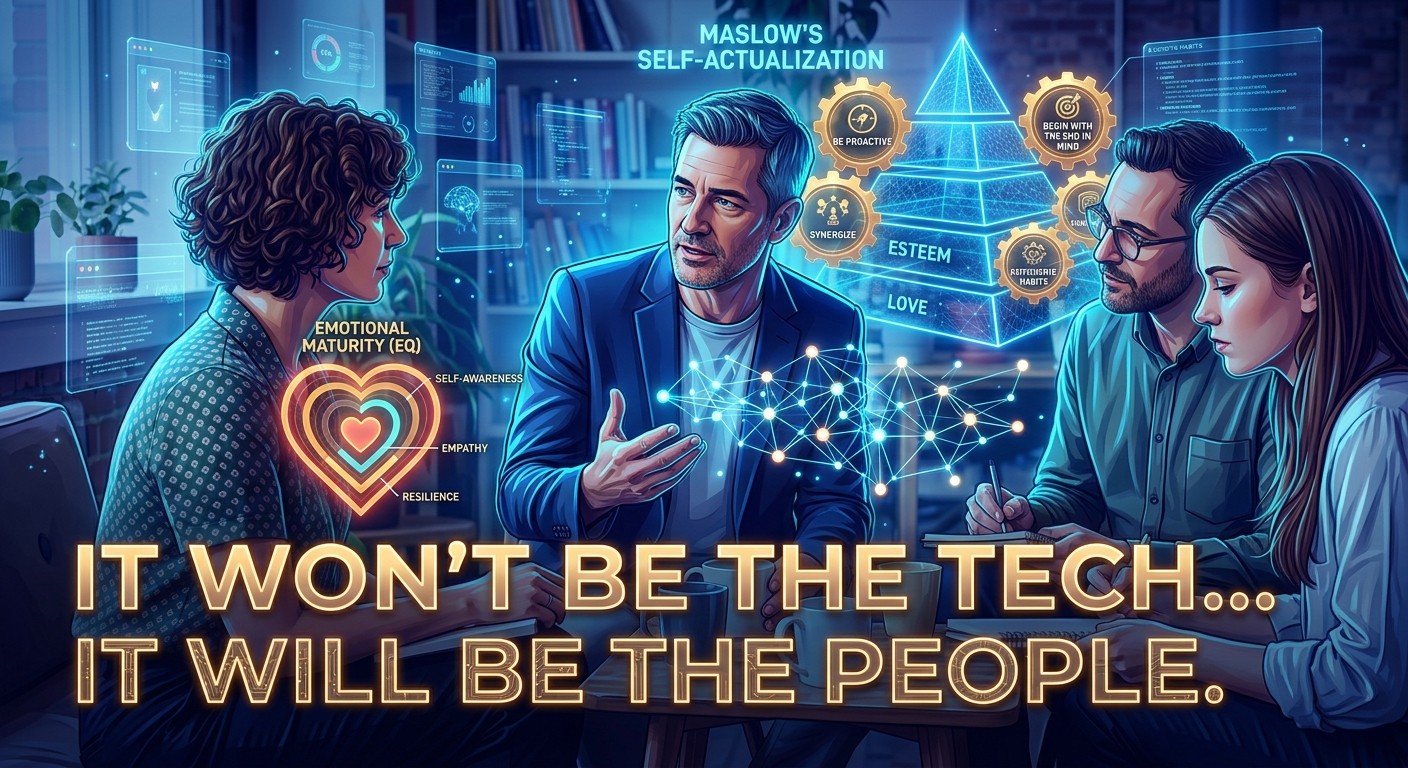
Saying AI failures are human failures may sound over the top, but is it? People build AI, train AI, instruct AI, define workflows and assist in a number of areas throughout the globe. Many to the betterment of society, some, not so much. Below I will attempt to show where high tech and low emotional intelligence will be the root cause for AI failures. I believe the technology will do what it’s intended to do. The question then becomes what are our intentions?
The Real Risk of AI
A few weeks ago, I found myself in yet another conversation about artificial intelligence. If you’ve spent any time online or in a corporate break-room lately, you know the drill. The conversation almost always splits into two extreme camps. On one side, you have the sci-fi doom-mongers who warn that autonomous neural networks are months away from gaining sentience and making humanity obsolete.
On the other side, you have the hyper-enthusiasts promising a Utopian future where no one ever has to draft an email or write a line of code again.
As I listened to people debate which of these two futures was more likely, I couldn’t help but feel that both sides were missing the entire point. They were treating AI as if it were an independent entity—a rogue asteroid heading for Earth, or a magic wand dropping from the sky.
We talked about this exact dilemma recently, and a simple premise stuck with me: If AI fails us, it won’t be a technology problem. It will be a people problem. Think about it this way. When a car crashes into a wall, we rarely blame the internal combustion engine. We look at the person behind the wheel. Were they distracted, were they driving recklessly, were they operating a high-powered vehicle without the maturity required to handle that kind of horsepower?
Technology is merely an amplifier. It takes human intent, multiplies it by a factor of a thousand and executes it at lightning speed. An algorithm doesn’t possess greed, panic, malice, or shortsightedness. But if the person wielding that algorithm is panicked, greedy, or shortsighted, the technology will happily scale those human flaws across an entire organization or society in milliseconds.
If we want to understand the true risks of the AI revolution, we have to stop staring at the code and start looking in the mirror.
How We Got Here: The Maturity Deficit
How did we land in a world where our technical capabilities are so vastly superior to our collective wisdom? To answer that, we have to look at what our culture has prioritized for the last half-century.
We built an educational and corporate ecosystem that idolized technical intellect, what we might call technical IQ, while treating emotional maturity as a nice-to-have “soft skill.” Here we rewarded the brilliant coder who couldn’t work well with others. Managers who hit their numbers through brute force were promoted, ignoring the toxic wake left in their path. We elevated raw execution above self-awareness, empathy, and long-term ethical thinking.
Now, we’ve handed that same culture a tool of unfathomable leverage. The cracks in our emotional foundation are no longer minor annoyances; they are existential hazards. To understand the depth of this maturity gap, it helps to plug our current relationship with technology into three classic frameworks of human development: Maslow’s Hierarchy of Needs, Stephen Covey’s 7 Habits, and the core principles of Emotional Intelligence (EQ)
Maslow’s Hierarchy and AI

Psychologist Abraham Maslow famously posited that human motivation moves up a pyramid, starting with basic physiological survival at the bottom and culminating in self-actualization at the top. If you look at how most organizations are deploying AI today, where are they spending their energy? Almost exclusively at the bottom of the pyramid. AI is being used as a sledgehammer for cost-cutting, headcount reduction, and squeezing every drop of transactional efficiency out of workers to protect short-term margins.
There is nothing inherently wrong with efficiency, but when efficiency becomes the only goal, we trap our human systems at the survival level. We rarely pause to ask the higher-order questions: How can this technology free people from drudgery so they can achieve self-actualization? How can it amplify human creativity, deep problem-solving, and meaningful purpose?
When leadership lacks the maturity to look beyond the bottom rung of Maslow’s ladder, technology becomes an instrument of anxiety rather than liberation.
Covey’s 7 Habits of Highly Effective People

Stephen Covey’s timeless leadership principles offer an even sharper critique of our current AI rush. The frantic sprint to adopt AI across almost every sector is the textbook definition of reactivity, a direct violation of Covey’s Habit 1: Be Proactive. Companies aren’t adopting tools because they have a clear, principled vision for how those tools will improve lives. They are adopting them out of pure FOMO (fear of missing out). They see a competitor release an AI feature, panic, and demand that their teams integrate something similar by next quarter.
This brings us to a failure of Habit 2: Begin with the End in Mind. When you deploy high leverage technology without a clear, human-centric end goal, efficiency becomes an end in itself. You end up building a faster train without ever checking if the tracks are heading off a cliff. Mature leaders
take a step back, regulate their anxiety, and clarify the destination before stepping on the accelerator.
Emotional Maturity

At its core, emotional maturity is about self-awareness, emotional regulation, empathy, and social responsibility. It’s the internal governor that stops us from acting purely on short-term impulse or fragile ego.
When you pair high technical IQ with low EQ, you get high-risk fragility. An individual or organization with low emotional intelligence will use power defensively, to control, to hoard resources, or to mask insecurities. Handing AI to a leader with low EQ doesn’t make them a better leader; it simply gives
their unexamined biases, insecurities, and short-term reactivity a mega-phone. Emotional maturity is what provides the moral clarity to know not just how to build or deploy a powerful system, but when and whether we should.
Steps Taken Today: Corporate Reality
If this all sounds like abstract philosophy, I have good news: the business world is already hitting this wall in real time, and the smartest leaders are paying attention.
For the past few years, companies poured billions into digital transformations, cloud migrations, and now AI rollouts, assuming that buying state-of-the-art software would automatically fix their
operational problems. Instead, many discovered that adding high-speed tech to a dysfunctional, low trust company culture simply produces high-speed dysfunction.
They are learning the hard way that an AI rollout isn’t an IT initiative. It’s a leadership maturity test.
| Traditional Adoption | Human-Centered Adoption |
| Focus: Technical Tools | Focus: Human Capacity |
| Software Rollouts | Navigating Anxiety |
| Prompt Engineering | Ethical Guardrails |
| Squeezing Output | Relational Trust |
| Automated Dysfunction | Sustainable Capability |
Corporate Real World Examples
- Leadership Institutes Are Pivot-Testing: Premier executive education bodies, such as the Center for Creative Leadership (CCL) and Blanchard, are actively reframing tech leadership. Their newest
programs don’t spend hours teaching executives how to write better prompts. Instead, they focus heavily on psychological safety, helping leaders guide their teams through the existential anxiety and job insecurity caused by rapid automation. They teach that empathy and strategic clarity are the real bottlenecks to tech adoption. - Culture Labs and Specialized Consultancies: Forward-thinking firms (like the Workplace Peace Institute and NextChapter) are developing tools that audit organizations for the EQ/IQ asymmetry. Before implementing major technological shifts, they assess a team’s capacity for conflict resolution, ethical conviction, and relational trust. They recognize that if a management team cannot handle honest internal feedback, giving them automated decision-making tools will lead to disaster.
- The Rise of Ethical Guardrails Over Mere Compliance: Corporate governance is moving beyond legally mandated compliance checkboxes toward genuine moral accountability. Mature organizations
are empowering ethics boards that don’t just ask, “Is this legal?” but “Does this honor the dignity of our workers and customers?
The emerging consensus among organizational psychologists is crystal clear: AI maturity is leadership maturity. Pumping millions into infrastructure while ignoring the emotional capacity of the people making the decisions just means you’ll make catastrophic mistakes faster than your
competitors.
The Future: Equipping the Next Generation
If we want to break this cycle permanently, we have to look downstream at where our cultural values are instilled: our schools.
For the last two decades, the global rallying cry in education has been singular: STEM, STEM, STEM. Science, Technology, Engineering, and Math were elevated as the absolute pinnacle of educational achievement. Parents were told that if their kids weren’t learning to code by middle school, they would be left behind in the modern economy.
While technical literacy is undoubtedly important, this laser focus on STEM created an unintended side effect. We treated humanities, ethics, art, and emotional development as secondary “nice-to-haves.” We unintentionally signaled to an entire generation that raw analytical execution was all that mattered. The result? We produced brilliant engineers, data scientists, and executives who know how to build incredibly complex systems, but lack the self-regulation and ethical grounding to consider the broader human consequences of what they’ve built.
The Evolution of Tech Education
| Old Model | Modern Integrated Model |
| Isolated STEM | Integrated STEM and SEL (Social and Emotional Learning) |
| Coding and Math | Technical Execution |
| Efficiency First | Empathy Driven Design |
| EQ Treated as Extra | Ethical Responsibility |
Thankfully, a quiet revolution is happening in primary and secondary education right now. It goes by the name of Integrated STEM + SEL (Social and Emotional Learning).
Educators have realized that teaching technical skills in an emotional vacuum is a recipe for creating high-leverage liabilities. As a result, major educational movements are actively putting emotional maturity on the exact same level of importance as technical prowess.
CASEL Frameworks Integrated into Tech
The Collaborative for Academic, Social and Emotional Learning (CASEL), the premier authority on SEL—has pioneered frameworks that integrate five core competencies directly into daily academic subjects: self-awareness, self-management, social awareness, relationship skills, and responsible
decision-making.
Instead of SEL being relegated to a 15-minute homeroom exercise, it is being woven straight into science and computer science classes. Students aren’t just graded on whether their code works; they are evaluated on how well they collaborated with their peers, managed their frustration when stuck, and considered the ethical implications of their project.
Empathy-Driven Design Thinking
In progressive project-based learning (PBL) environments, students don’t simply build a piece of software or assemble a robot. They are required to use design-thinking frameworks that begin with empathy.
Before typing a single line of code, students must conduct interviews with real users, map out human emotional needs, analyze potential algorithmic biases, and predict how their creation might affect vulnerable populations. In these classrooms, empathy isn’t treated as a soft feeling—it is graded as a rigorous technical requirement.
AI Literacy That Demands Moral Accountability
Districts that are proactively adopting K-12 AI guidelines are pairing tool usage with critical ethics. Kids are explicitly taught a fundamental truth: The algorithm has no feelings, no moral compass, and no personal accountability. Therefore, the human who inputs the prompt and deploys the output carries 100% of the emotional and ethical responsibility for the outcome.
By putting emotional maturity on par with STEM, these educators are preparing the next generation for the real world. They are building a future workforce that understands a simple rule: Technical capability builds the engine, but emotional maturity must serve as the steering wheel.
The Use of Tech
When we step back and look at the trajectory of human history, technology has always acted as an extraordinarily clear mirror. It reflects our true values back at us with absolute clarity.
Examples:
- Fire warmed our homes, but it also burned down cities.
- Splitting the atom gave us carbon-free electricity, but it also gave us the threat of total destruction.
- The internet gave us access to the sum total of human knowledge, but it also scaled polarization and loneliness.
AI will be no different. It will neither save nor destroy us on its own. AI has no agency, no soul, and no motives. It will simply magnify whatever state of mind we bring to it. If we bring greed, fear, and emotional immaturity, it will scale chaos. If we bring empathy, wisdom, and moral clarity, it can help
us solve problems that have stumped humanity for generations.
The ultimate competitive advantage in an increasingly automated world won’t be owning the fastest neural network, holding the largest dataset, or writing the slickest prompt. Those technical elements are rapidly becoming commoditized.
The real differentiator—the true steering wheel of superintelligence—will be our human maturity. It will be our ability to live by Covey’s proactive habits, to reach for Maslow’s self-actualization, and to cultivate the deep emotional intelligence required to ask the ultimate human question:
Not just “Can we build this?”—but “Should we?”
WARNING: Surrendering our Edge
One final part where people can play a negative role in the advancement of AI. The gradual, voluntary atrophy of human agency.
Because AI systems are designed to make life smoother, drafting our thoughts, calculating our decisions, optimizing our schedules, and resolving our friction, they create a powerful incentive to step back. The danger isn’t a sudden, catastrophic takeover of AI, it’s a quiet, comfortable delegation of the very things that make us human.
Let’s take a look at three areas we need to guard against. Again, this relates to emotional maturity.
- The Erosion of Cognitive Friction – Learning, critical thinking, and moral growth require friction. When you struggle through a difficult draft, negotiate a tough conflict, or spend hours solving a complex problem, your brain builds the mental muscle required for deep judgment. If AI removes every bit of friction from daily life, humanity risks trading mastery for convenience. When thinking becomes optional, people stop practicing it, meaning that when an unexpected edge case or critical crisis occurs, the human capacity to evaluate, challenge, or override the technology may no longer exist.
- Algorithmic Homogenization – As millions of people rely on the exact same underlying models to generate ideas, write copy, frame arguments, and make policy choices, human thought risks narrowing. We begin to optimize for what the algorithm favors: average, polished, low-risk consensus. The loss of weirdness, authentic voice, radical creative intuition, and unstructured human variance is a massive, quiet tax on culture.
- The Shift from Alignment to Atrophy – Most tech discourse asks: “How do we make sure AI stays aligned with human values?” A much deeper question is: “What happens to human values when we stop exercising them?” If people outsource empathy, ethical choices, self-regulation, and decision-making to external software, human values don’t just stay static—they weaken. A super-convenient world might produce a generation of people who are technically supported, yet emotionally and intellectually fragile.
Summary
I think the summary for this is pretty simple. As a people, we need to grow up. There’s nothing wrong with making profit, it’s a good thing and drives innovation. There’s nothing wrong with national security or protecting your families. However, putting profit over product or people? Using advanced technology for the sole purpose of building better weapons and surveillance gear? These are glaring signs of a lack of emotional maturity. Whether it’s greed, fear, insecurity, etc. face it head on. Don’t avoid the difficult conversations.
Look there’s plenty of things we can focus on. Instead of the drive for profit at all costs or the having the means to destroy the world twice over, how about putting that same creative energy to use on fixing the planet, feed, clothe and shelter all people? How about bringing medical care and education to all. These are all huge challenges that technology, specifically AI, can be deployed to assist.
The ultimate hazard isn’t that AI becomes too powerful; it’s that humans become too passive. Technology should be built to stretch human capability, not replace the necessity of human effort.
Keeping emotional maturity, critical thinking, and moral agency at the center of the equation is the only way to ensure AI serves the species, rather than the other way around
It’s the 21st Century. We’re getting older. Time to grow up and take the next step towards something better.
What do you think? Drop me a comment and let me know your thoughts.