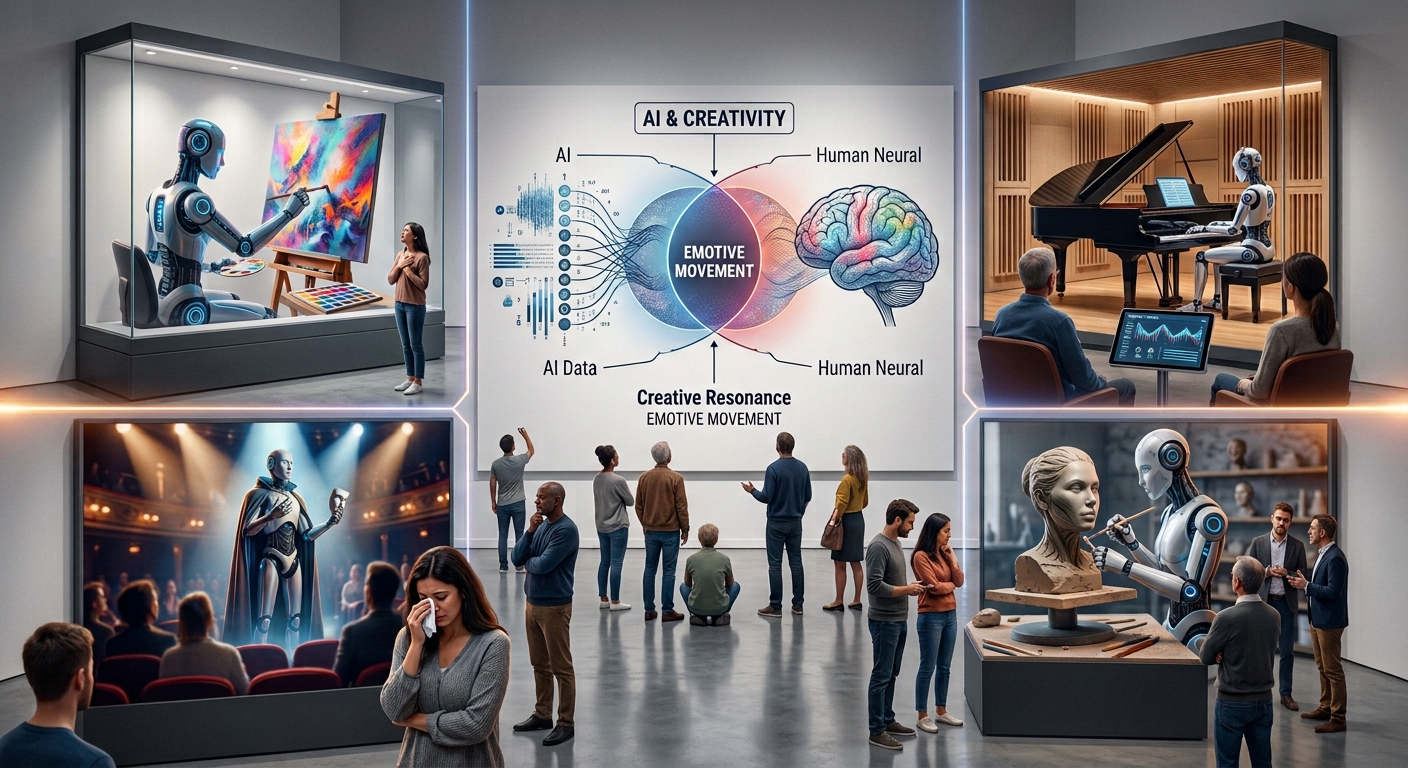
AI creativity, the duality of art. What is AI art and what is this duality? This had my head spinning. I wanted to crawl down this rabbit hole and see what I can learn. Having been a musician in my youth, I find this topic fascinating and filled with questions.
To get a complete picture in my mind, I went back to see if there were any tests, like the Turing test, but around art, not just text based interactions. Then I want to understand more on how the AI creates art.
Once understanding tests and techniques, I wanted to dive into the human experience on art. This is a widely debated topic and becomes almost circular in nature. I believe that’s a direct result of the duality of art.
Turing Tests for Art
I was surprised that the debate surrounding art extends all the way back to the 1960’s. Let’s explore 3 experiments which are types of Turing type tests applied to art.
Three Distinct Tests
- Visual Art: The Mondrian Experiment (1966)
- Summary: Long before modern generative AI, computer arts pioneer A. Michael Noll created one of the earliest artistic Turing tests.
- The Experiment: He used a computer program to generate a digital artwork mimicking Piet Mondrian’s famous geometric style (Composition with Lines). He then presented both the real Mondrian and the computer image to a test audience.
- The Result: 59% of people preferred the computer-generated picture, and only 28% correctly identified which one was the real Mondrian.
- . Classical Music: David Cope’s EMI (1990s)
- Summary: Music processor and researcher David Cope created an algorithm called EMI (Experiments in Musical Intelligence) designed to analyze a composer’s style and generate new works.
- The Experiment: In a public test, audience members and trained musicologists listened to three Bach-style pieces: one composed by J.S. Bach, one written by a human composer in Bach’s style, and
one generated by EMI. - The Result: The audience mistook EMI’s piece for authentic Bach. Even more embarrassingly, they rated the actual human-written piece as sounding “too mechanical and computer-generated.”
- Modern AI: Double-Blind Visual Turing Tests (2020s)
- Summary: With tools like Midjourney, DALL-E, and Stable Diffusion, researchers conduct formalized, double blind visual Turing tests.
- The Experiment: Participants are shown pairs of images (paintings, digital art, photography, or watercolors) where one is created by a professional human artist and the other by generative AI.
- The Result: Overall human accuracy in distinguishing AI art from human art hovers near 50%–60% (barely better than a random coin flip). Where humans do succeed, it is usually by looking for logic errors in subtle details (like structural lighting inconsistencies or anatomy) rather than evaluating artistic style.
The Related Alternative
Because passing a blind taste test might just mean an algorithm is good at imitating patterns, computer scientists created the Lovelace Test (named after Ada Lovelace). To pass this test, an AI must generate a piece of creative work that the AI’s own creator cannot explain or predict based
on its initial code.
Looks like we’ve been diving into art and technology since the 1960’s to the present day. So, how does AI even do this?
How AI Creates
How AI creates is very interesting. Some may say that people use their subconscious or even their dreams to get insight into what they create. Then they apply their unique skill set to bring it to life. It should then come as no surprise that AI uses a similar technique carried out through complex math. I won’t repeat the details on how AI dreams. If you’d like to get insight into that, check out my article titled Does AI Dream.
We all know AI relies on data, lot’s and lot’s of data. Imagine being able to recall every word from every book as well as every piece of art across all genres. If we stop there, we’d have an incredible duplication machine, one that can output anything and everything you can think of. Is that art or duplication? Personally I think that’s just a reproduction or duplication machine. AI can do that, but as our tests above shown, they can also create unique pieces as well.
Let’s take a look at how AI gets creative. If interested in more detail, again see my article titled Does AI Dream.
World Models
Through reinforcement learning, an autonomous car learns by physically driving millions of miles. If it crashes into a tree, it gets a “negative score” and learns not to do that again. But crashing real cars is expensive and dangerous. To solve this, researchers build a World Model inside the car’s brain.
Once it understands those laws, it compresses them into latent space (its mathematical summary of reality)
First, the car learns physical laws from real video footage (how friction works, how pedestrians walk, how traffic lights change).
Once the World Model is built, the AI no longer needs to drive on a real road to get smarter. It literally “dreams” hypothetical futures inside its latent space.
This leads AI to Experience Replay (Memory consolidation): The AI takes real past events stored in a memory buffer and re-plays them over and over during training so it doesn’t forget them. (Like re-watching game film.)
This is latent dreaming (generative imagination) for our AI. Here the AI uses its understanding to invent new, synthetic events it has never seen.
What the heck does self-driving cars have to do with art and creativity? In your mind, substitute art for cars. A world like we mentioned above, full of every book, magazine and article ever written. A world where every genre of art is already know. Like our car example above, the AI is then freed to explore, on it’s own, creating novel pieces (like car scenarios).
The Duality Emerges
Now things get real interesting. We learned above how an AI can take stored data, evaluate and dream unique combinations when producing a piece of art work. Yes, it’s done mathematically, but from a higher level, isn’t this what people do when they create? They may be formally trained or not, but when they go through their creative process, they rely on their experiences to create new pieces. The key is ‘experiences’. Does it matter if the experience is generated through math or emotion?
So, there’s our duality between creator and observer. I was shocked at how easy it was to arrive at this conclusion. We see it all the time.
- The diner enjoys a delicious meal. A food critic enjoys the meal but also wants to know the ingredients, how it was made. They’re interested in the process and how that process was carried out.
- The user of a piece of software is interested in ease of use, the problem it solves or the convenience it creates for them. They experience the fluidity, the reliability and then make their decision as to whether they like it or not. The technical folks want details. Which language was it written in, what’s the framework like, how are they implementing security and the list goes on.
Where Does That Leave Us?
Where does that leave us? Having been a musician and having reached out to my musician friends, it would seem we’re stuck with this duality. The creator should be compensated for their craft. Protections need to be in place so they receive that compensation. When the creator is a musician, there’s the question around how does this transfer to live performances? We’ve all been there, creator or observer. There’s something about a live performance, the free style interplay between the musicians, the energy, the vibe. That is all part of the experience. I’ve enjoyed all kinds of music over the years an saw a number of bands in concert. If I enjoy an artist, but never saw them live, it doesn’t prevent me from continuing to enjoy the music.
Taking the above practicalities into account, it does scream for separation between art people generate vs what AI generates. Perhaps this could lead to an entirely new category or genre, AI generated. With my creator hat on, I would champion that approach because it does factor the ‘who’ and the ‘how’ something was created.
As an observer, well I go in the opposite direction. Whether a song, a painting, a sculpture or a play, with my observer hat on I’m interested in the experience. Period. How does the piece impact me personally? How does it make me feel? What does it make me think of? It’s highly personal.
Summary For The Creator
Well, here we are, the summary. This is where I wrap it all up into a logical conclusion, right? Wrong. The duality is among us, has been among us since time began. This duality is part of the human condition and I believe we’ll always have it. Whether dining, enjoying art or a plethora of other things, it’s who we are. Ever hear the expressions, you’ve got good taste. How about, love what you did with the room, or the outfit, etc. etc.
The ‘answer’ if that’s the right word depends on which hat you’re wearing. Yes, the artist deserves credit and compensation for their craft. I don’t see this changing. I do see the emergence of a new category or genre, separating what people have created vs what AI has created.
Summary For The Observer
I also believe art is in the eye of the beholder. Wearing this hat I’m more concerned with how the piece makes me feel. The reaction of hearing, seeing or interacting with the piece. It’s all about the connection. I don’t see that going away anytime soon nor should it.
Summary – Overall
Overall I believe in the separation of who and how it was created. I believe a separate category or categories should be created. For example, if the piece is purely created digitally, then it should be classified as such. If the piece was created by combining the artists craft and AI, then it too should be classified as such. Share the credit because it goes both ways. Lastly, if a person created the piece, that too (like today) remains in the category it is today. Look, I don’t see this as a competition between people and AI, I see it as simply another form or art, another genre.
Of course living in a fiat or money driven economy, there remains questions around monetary compensation. When a piece is purely digital, was it the AI or the person instructing the AI that gets compensation? Same question for the joint efforts? If we say give credit where credits due, shouldn’t the vendor of the AI be compensated? I have no idea what the future holds, so for now I’ll stick to the current system. Yes, the vendor is compensated upon purchase of the AI or time with the AI. It’s basically factored in. The artist buys the brush or a musician the instrument and the vendor gets compensated through the purchase. The vendor doesn’t get compensated for the success of the art generated.
I’ll close by saying if it touches you, it’s art. Period. For the casual observer, that’s all that matters. If you’re an attorney, buckle up, you’ve got a whole new area of case law coming. 😂
What do you think? Creator or observer? Both? Drop a comment and let me know your thoughts!